Back to our work Case study, NextGen Mobile

A phone shop that owns its storefront.

NextGen Mobile sells handsets in Rajshahi. Instead of renting a store on someone else's platform, we built them one: a custom storefront, a search engine written for their catalogue, cash-on-delivery checkout, and an order console. No subscription, no cut of every sale.
The build

One Worker. The whole shop.

Storefront, checkout and admin, built from scratch
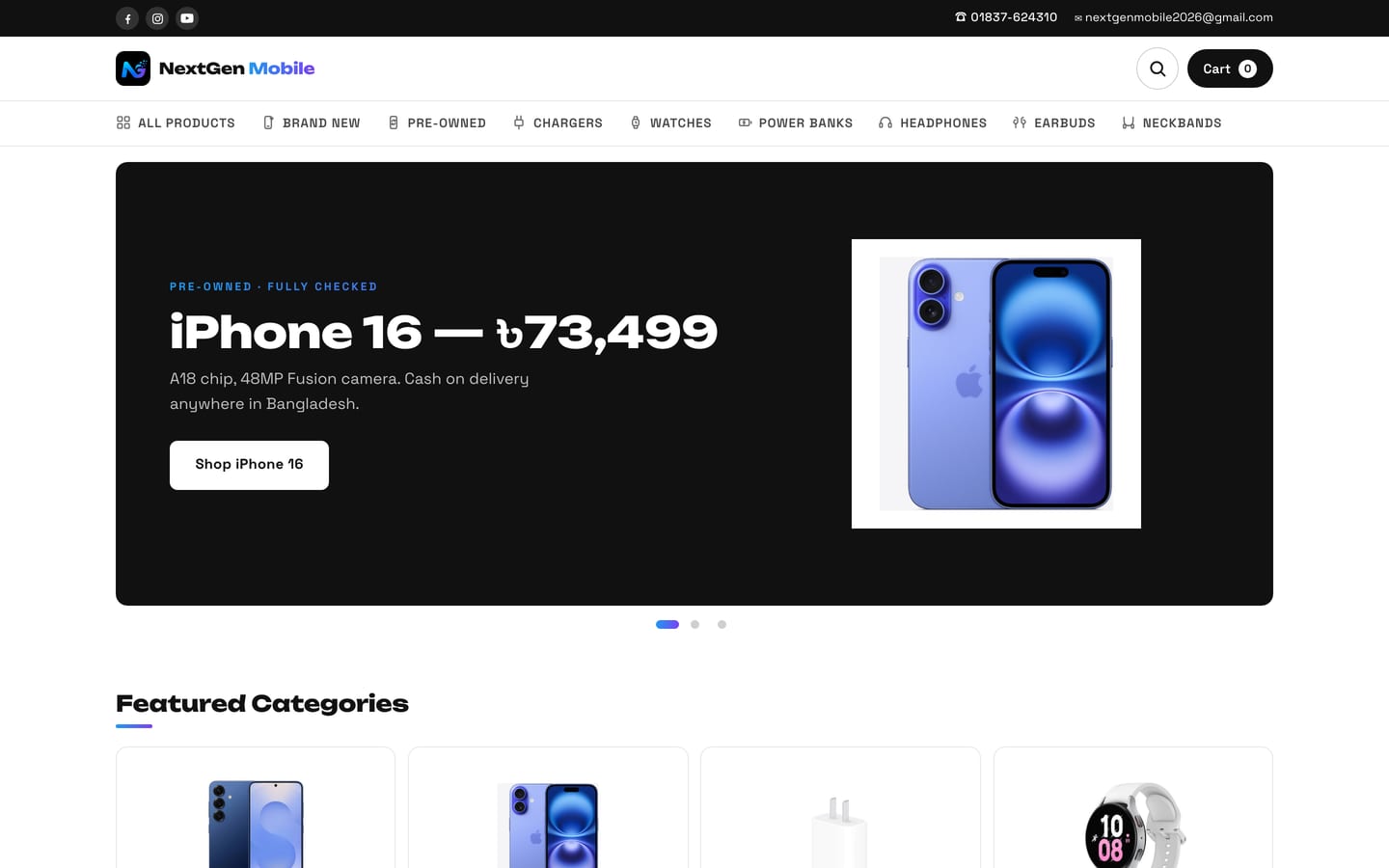
The NextGen Mobile homepage
The work

The work, up close.

15 pieces of the build, every one a real screen from the live site.
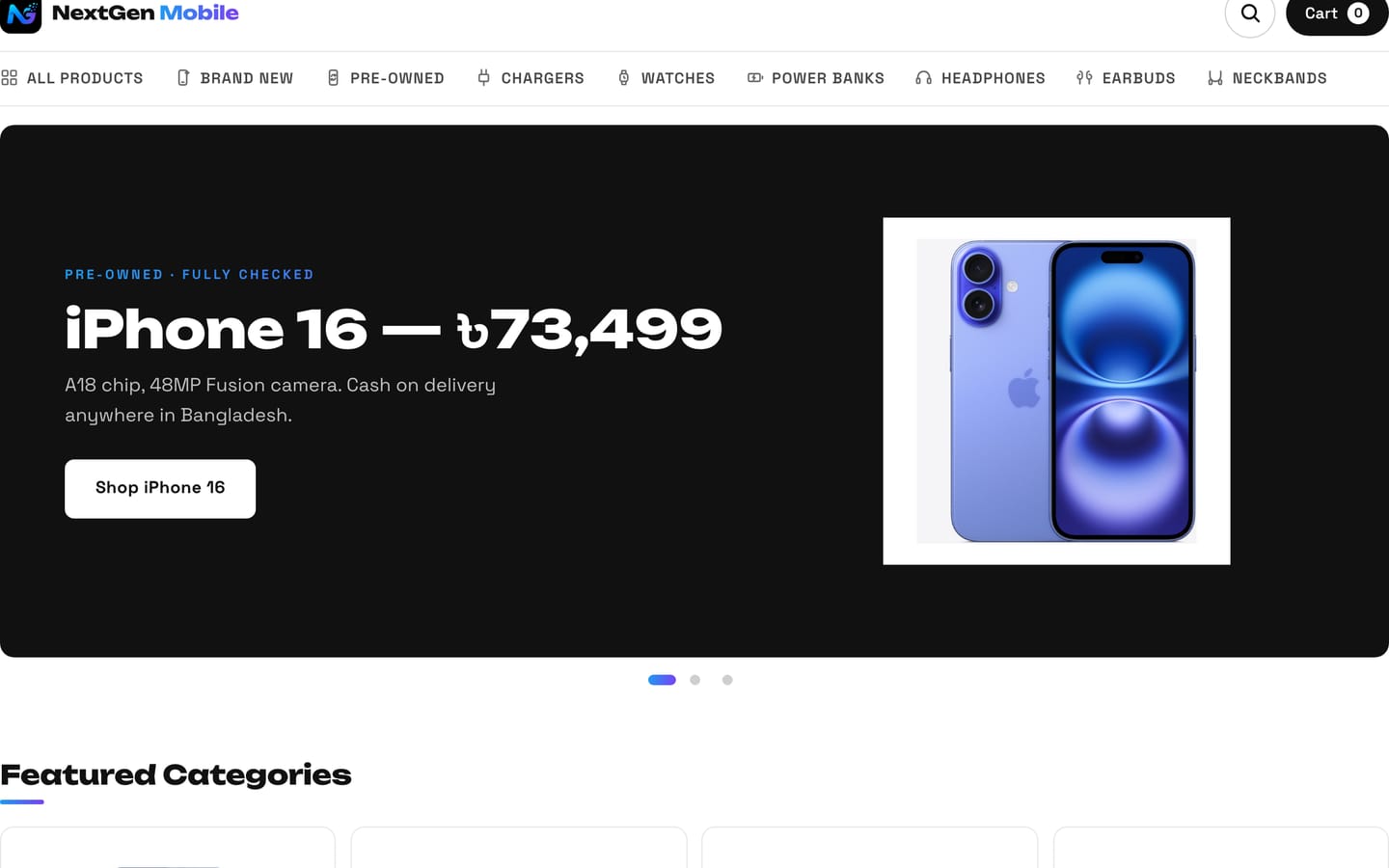
The NextGen Mobile homepage with a rotating promotional banner
Storefront

A shop window that opens instantly

Every page is assembled in a Cloudflare Worker at the edge and sent as finished HTML. There is no client framework to download and parse before a customer sees a phone, which matters on the mobile connections most of this traffic arrives on.

Server rendered at the edge, no client framework
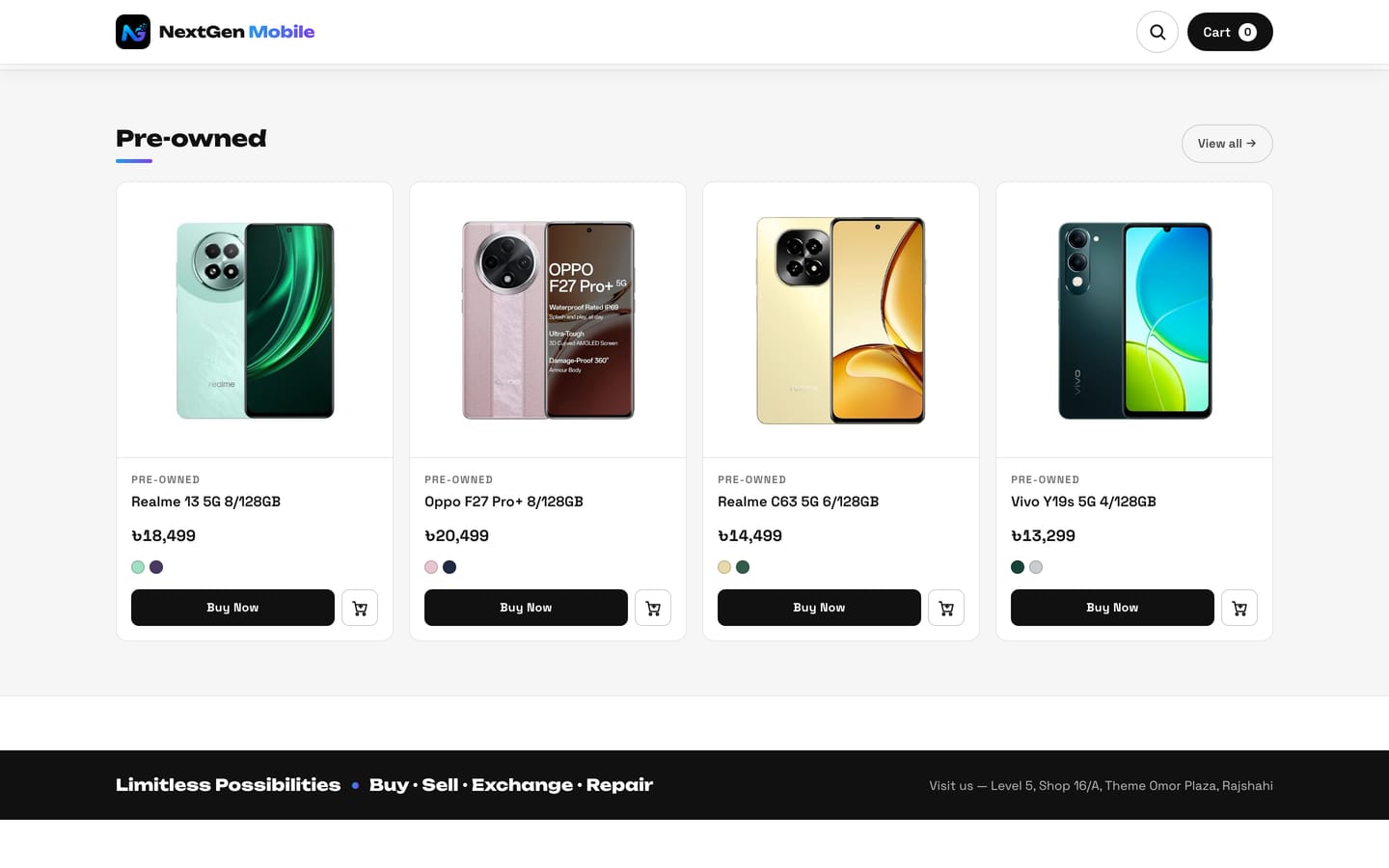
The pre-owned product row on the NextGen Mobile homepage
Real stock, front and centre

The inventory is the homepage

Pre-owned handsets are what the shop actually moves, so they get a row on the front page with price, colour options and a direct buy action. A customer can go from landing to a product page in 1 tap, without opening a menu.

Buy action on every card
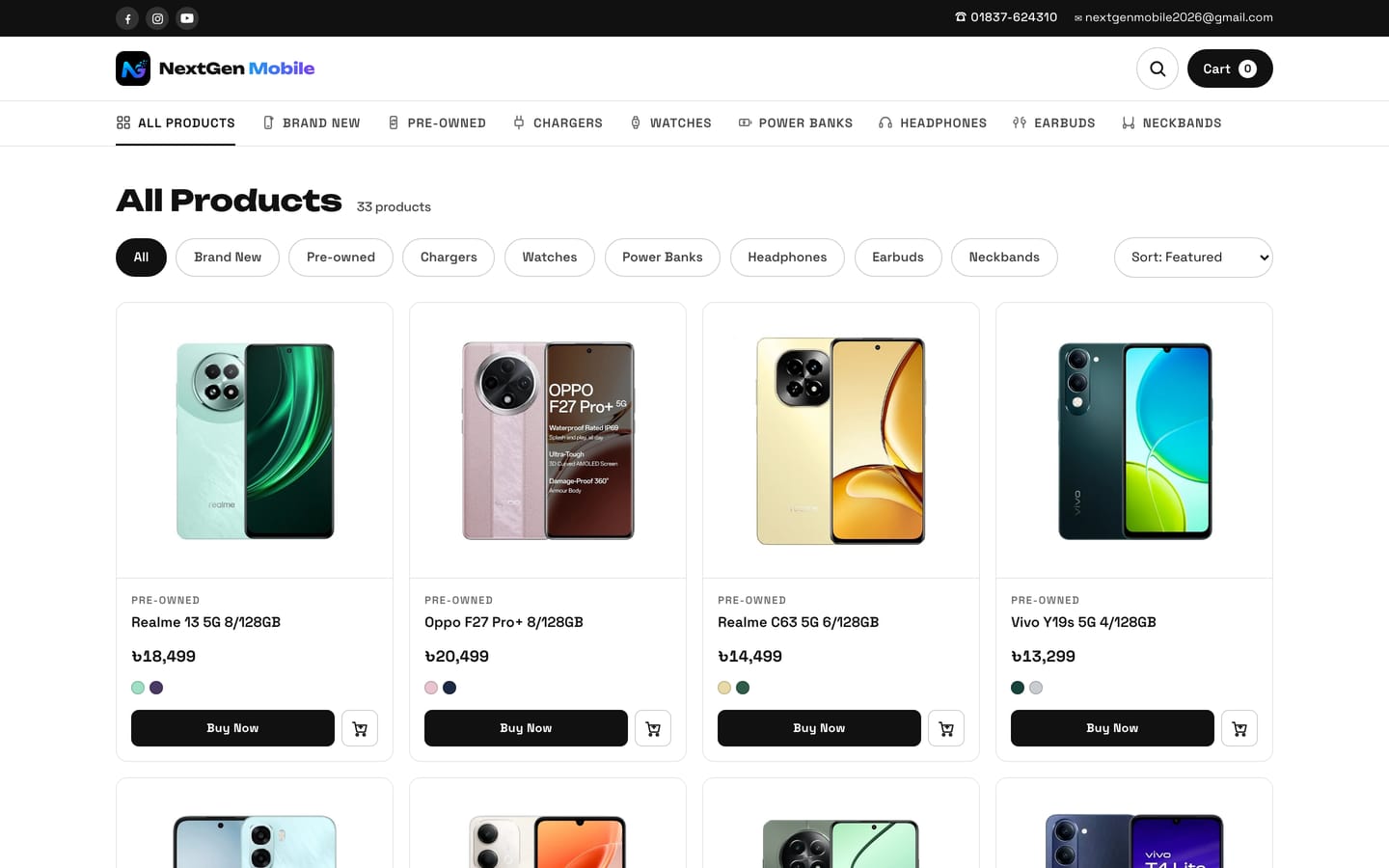
The full product catalogue with category filters and sorting
Catalogue

8 categories, filtered without a reload

One catalogue page handles category filters, text queries and sorting by price or discount. Each combination is a real URL, so a filtered view can be shared in a message or linked from a Facebook post and still land correctly.

Every filter state is a shareable URL
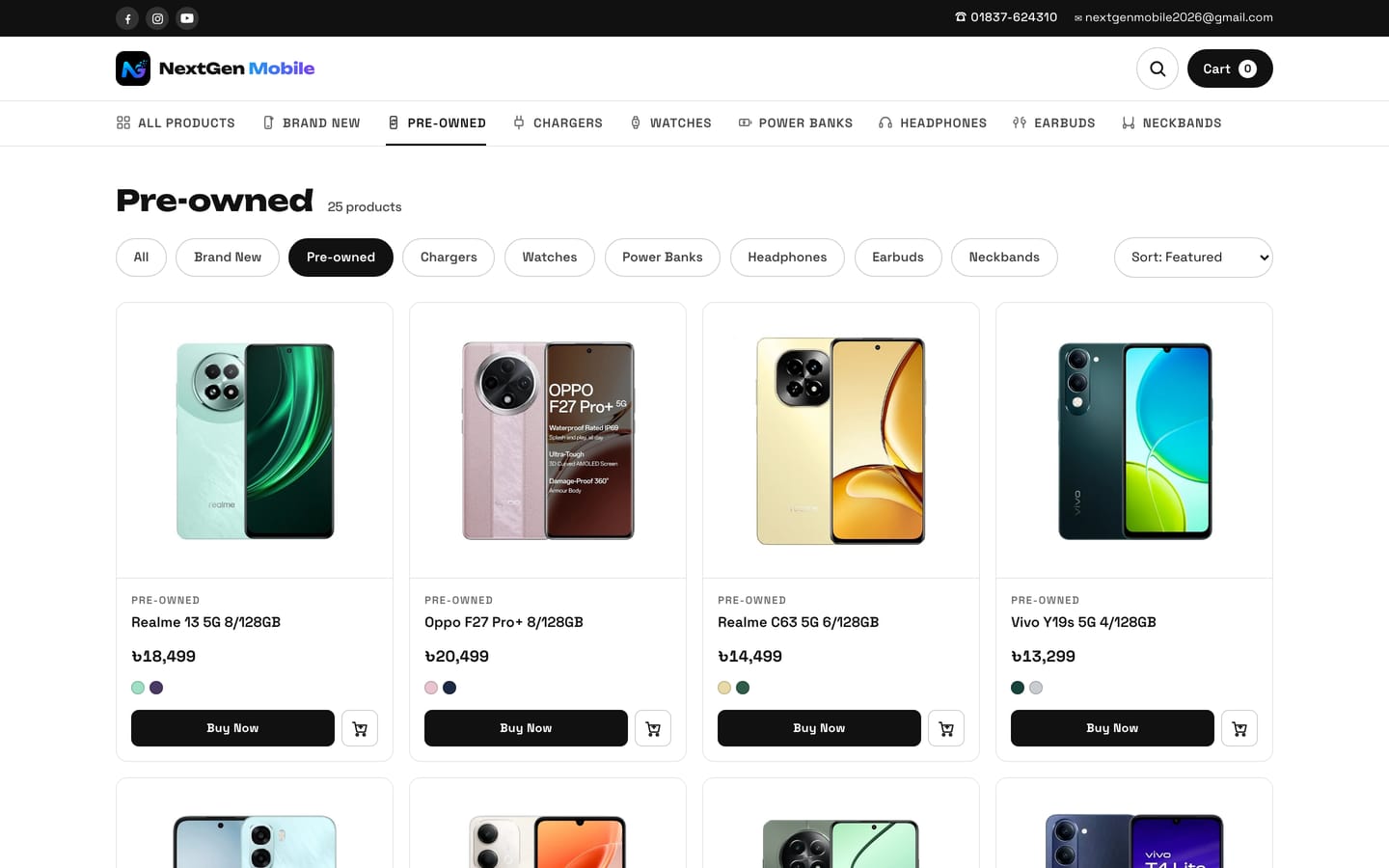
The pre-owned category listing with 25 handsets
Pre-owned

Where the business actually lives

25 pre-owned handsets, each with its own colour options and condition-appropriate pricing. Second-hand stock is the hardest thing to sell online because every unit is different, so each one gets a full product page rather than a line in a list.

25 handsets, each individually listed
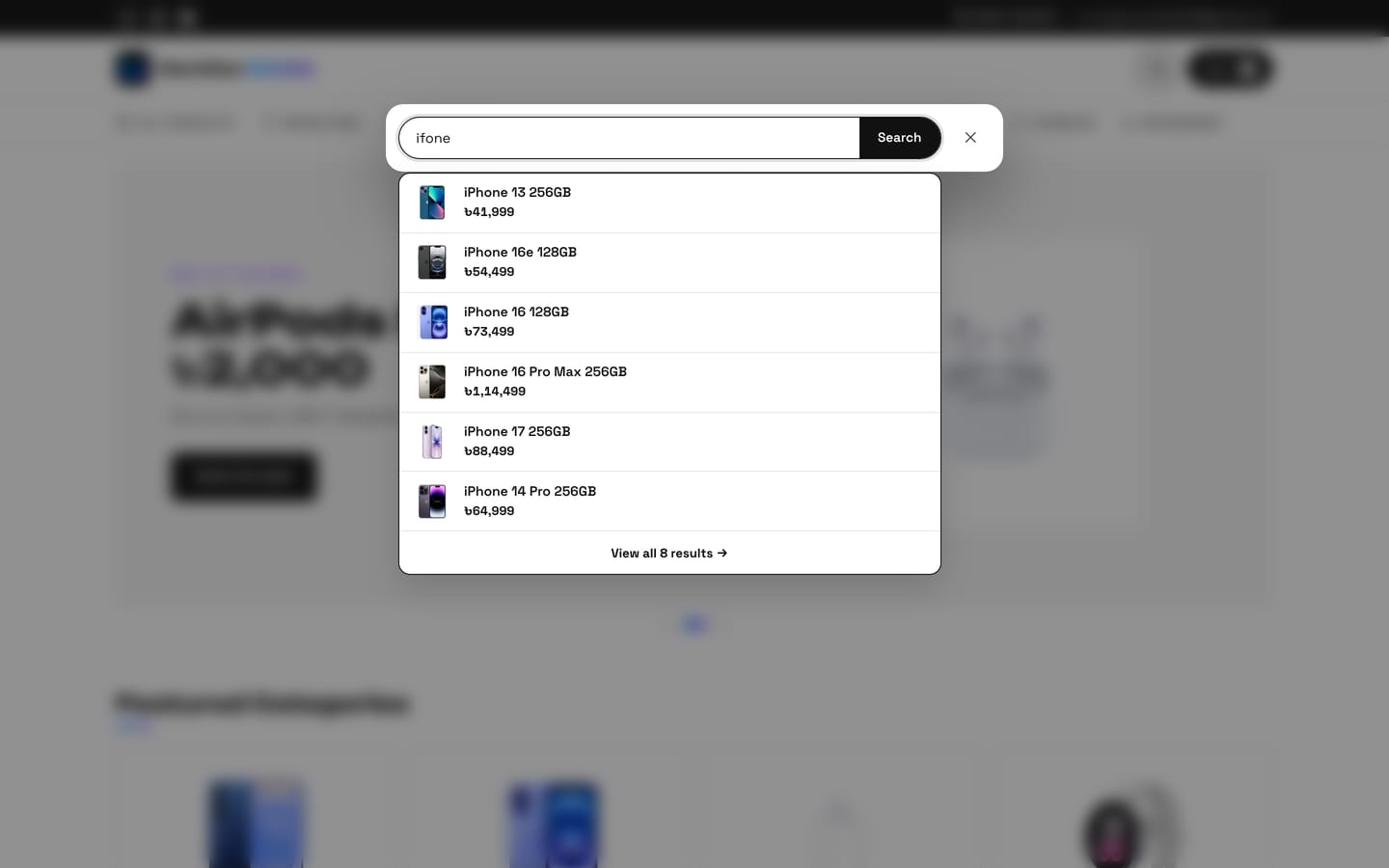
The search overlay showing iPhone results for the misspelling ifone
Search

It finds the phone they meant, not the one they typed

This is a real query. The customer typed "ifone" and the overlay returned every iPhone in stock. The relevance engine was written for this catalogue: edit-distance typo tolerance, a synonym table covering the words Bangladeshi buyers actually use, and tokenization that handles Bengali script alongside English.

Typo tolerant, synonym aware, built for this shop
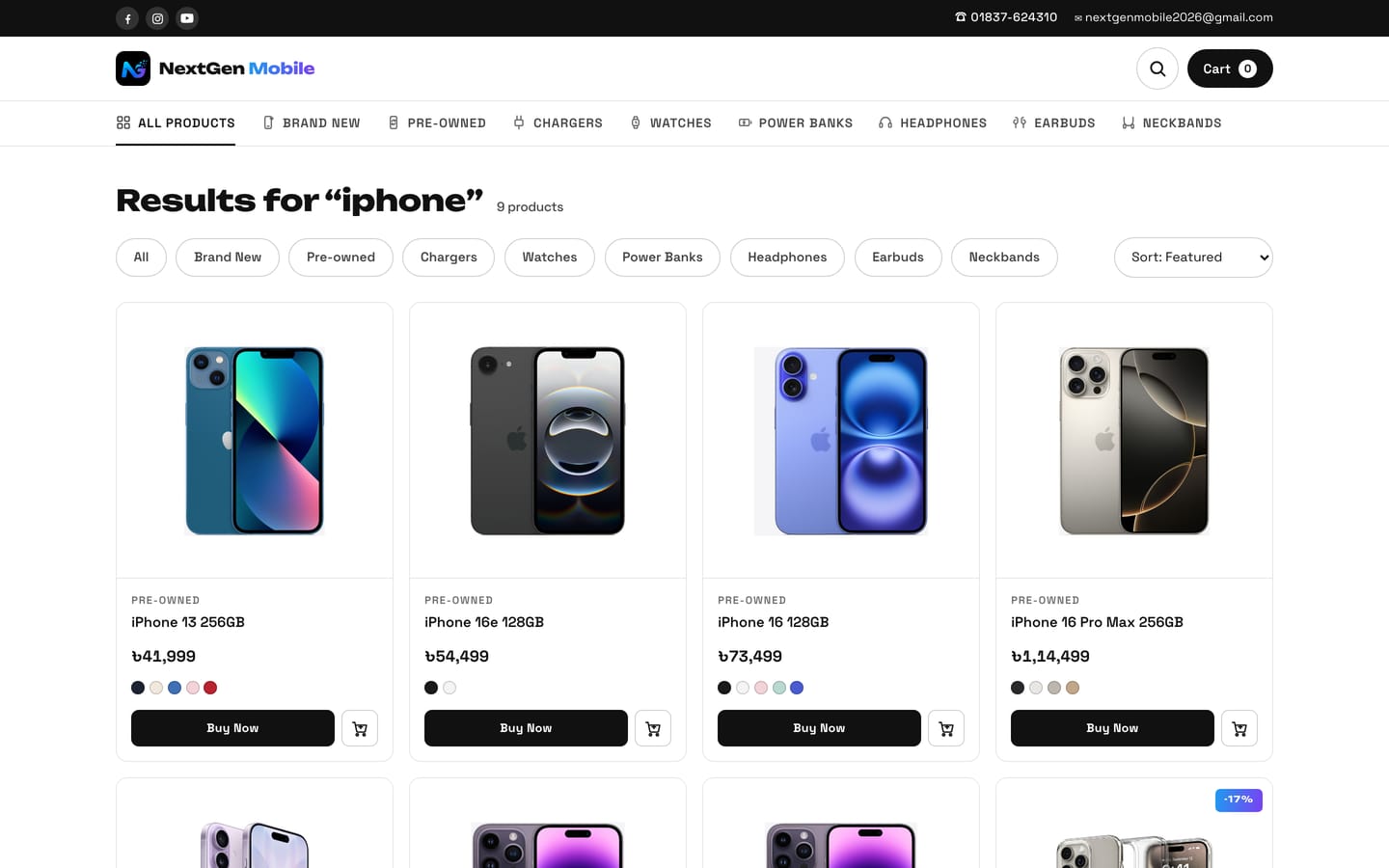
Search results page for the query iphone
Results

Search results keep the filters

A query lands on the same catalogue surface as a category, so the customer keeps the filter chips and the sort control instead of being dropped into a stripped-down results list. Weighted scoring puts exact matches first and prefix matches next.

Search and browse share one interface
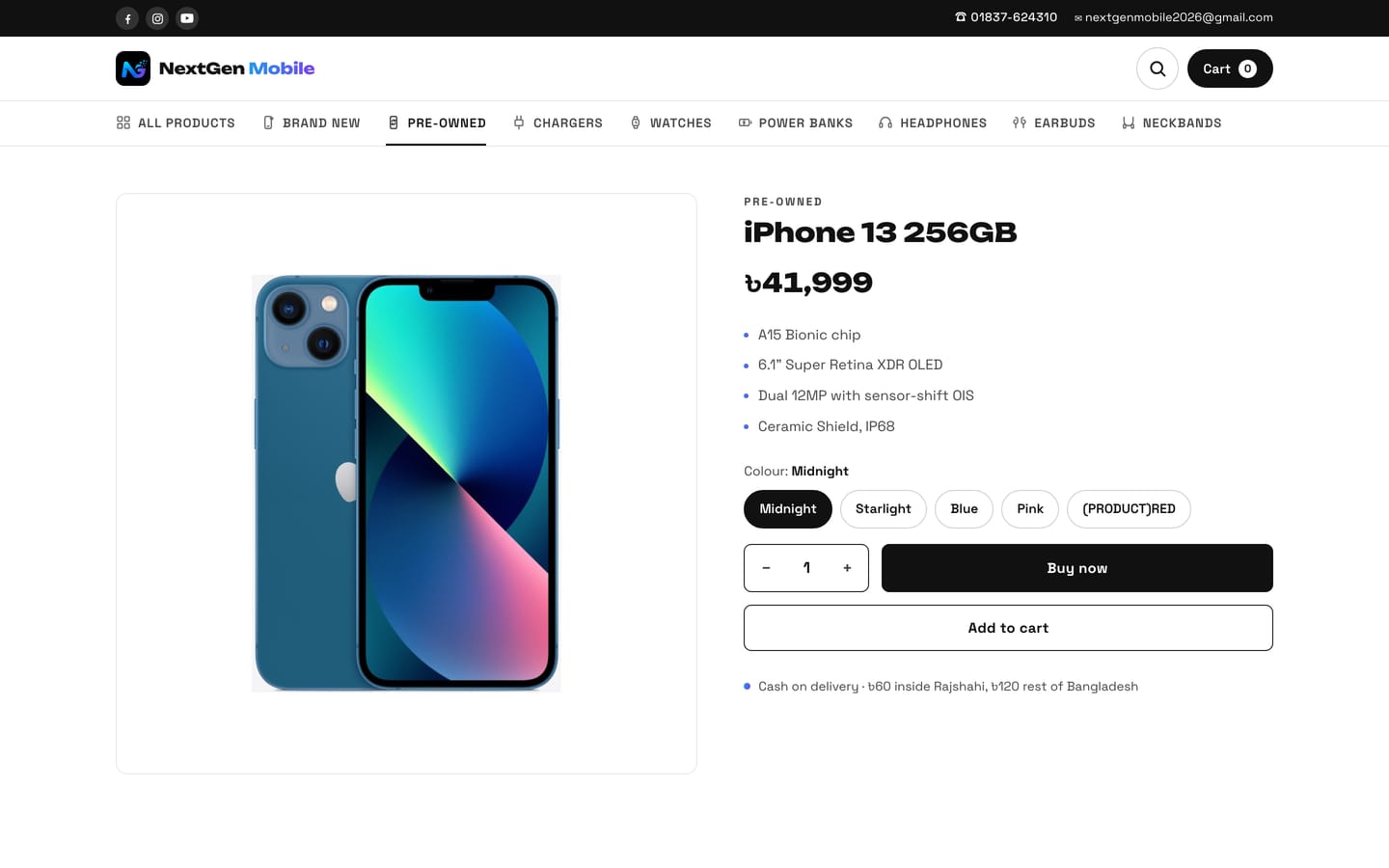
The iPhone 13 256GB product page
Product page

Enough detail to decide, nothing to wade through

Price, key specifications, colour choice, quantity, and 2 clear actions. Buy Now goes straight to checkout for a customer who has already decided; Add to cart is there for the one who has not. Structured data on every product page means the listing can surface correctly in search results.

Product schema on every listing
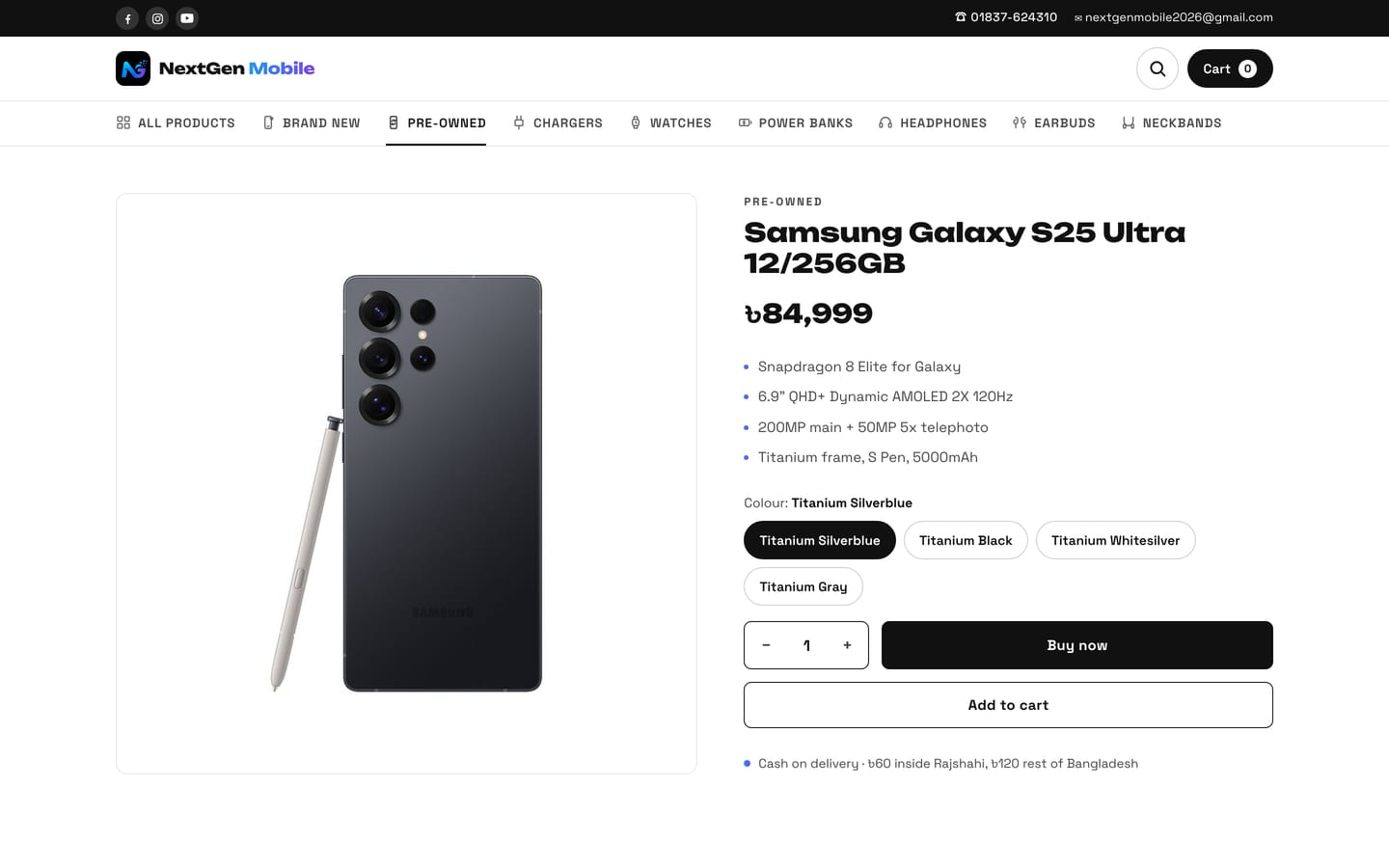
The Samsung Galaxy S25 Ultra product page showing colour variants
Variants

Colour is part of the order, not a note in the comments

Selecting a finish changes what goes into the cart, and the same handset in 2 colours becomes 2 separate lines. The shop packs exactly what was ordered instead of calling the customer back to ask, which is where cash-on-delivery orders usually go wrong.

Colour carried through cart, order and email
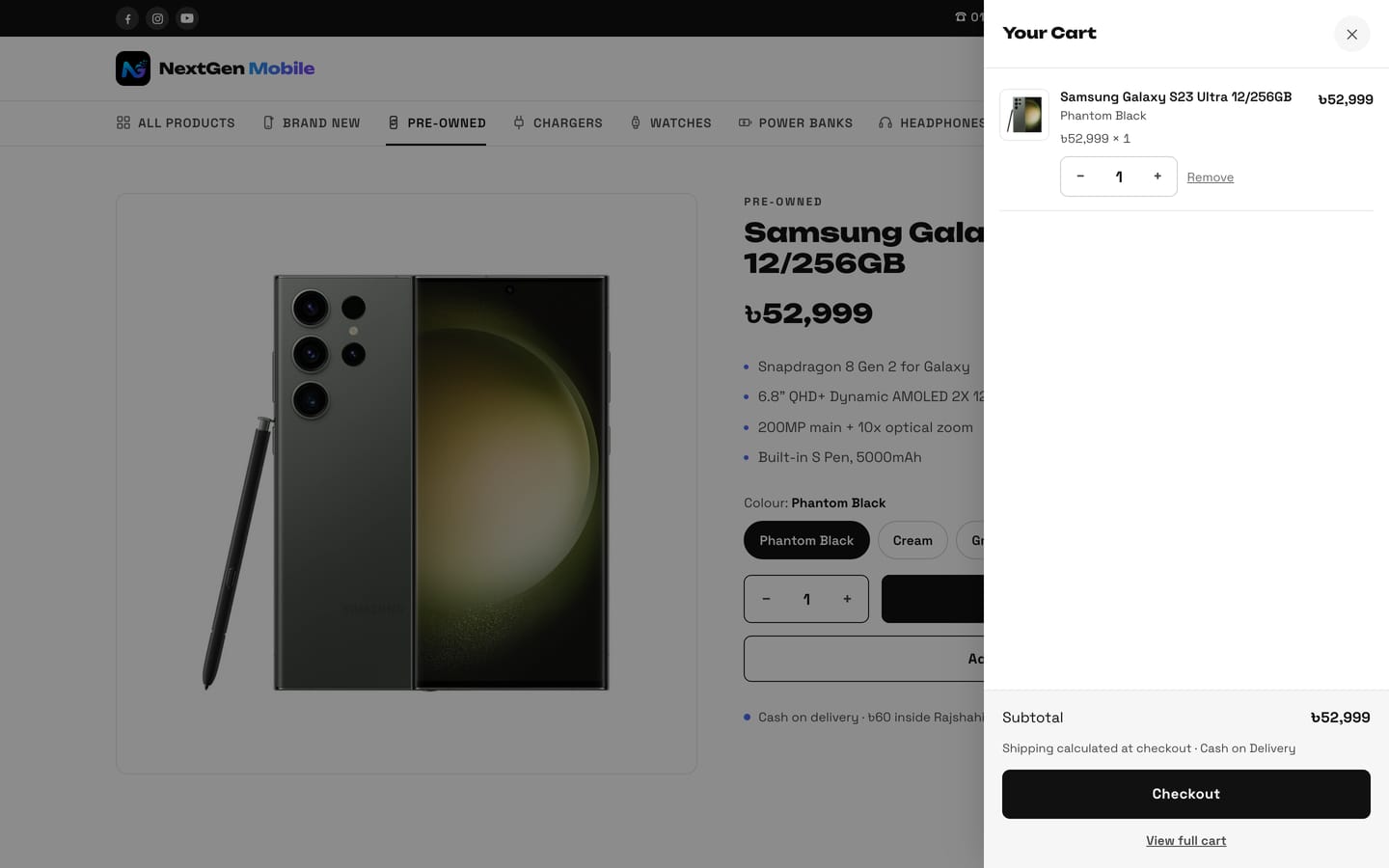
The slide-in cart drawer after adding a handset
Cart drawer

Adding to the cart never costs you your place

The drawer slides in over the product page and the customer keeps browsing. Rapid taps are queued and applied in order, so a customer on a slow connection who taps twice does not end up with a cart that disagrees with itself.

Requests serialized to survive slow connections
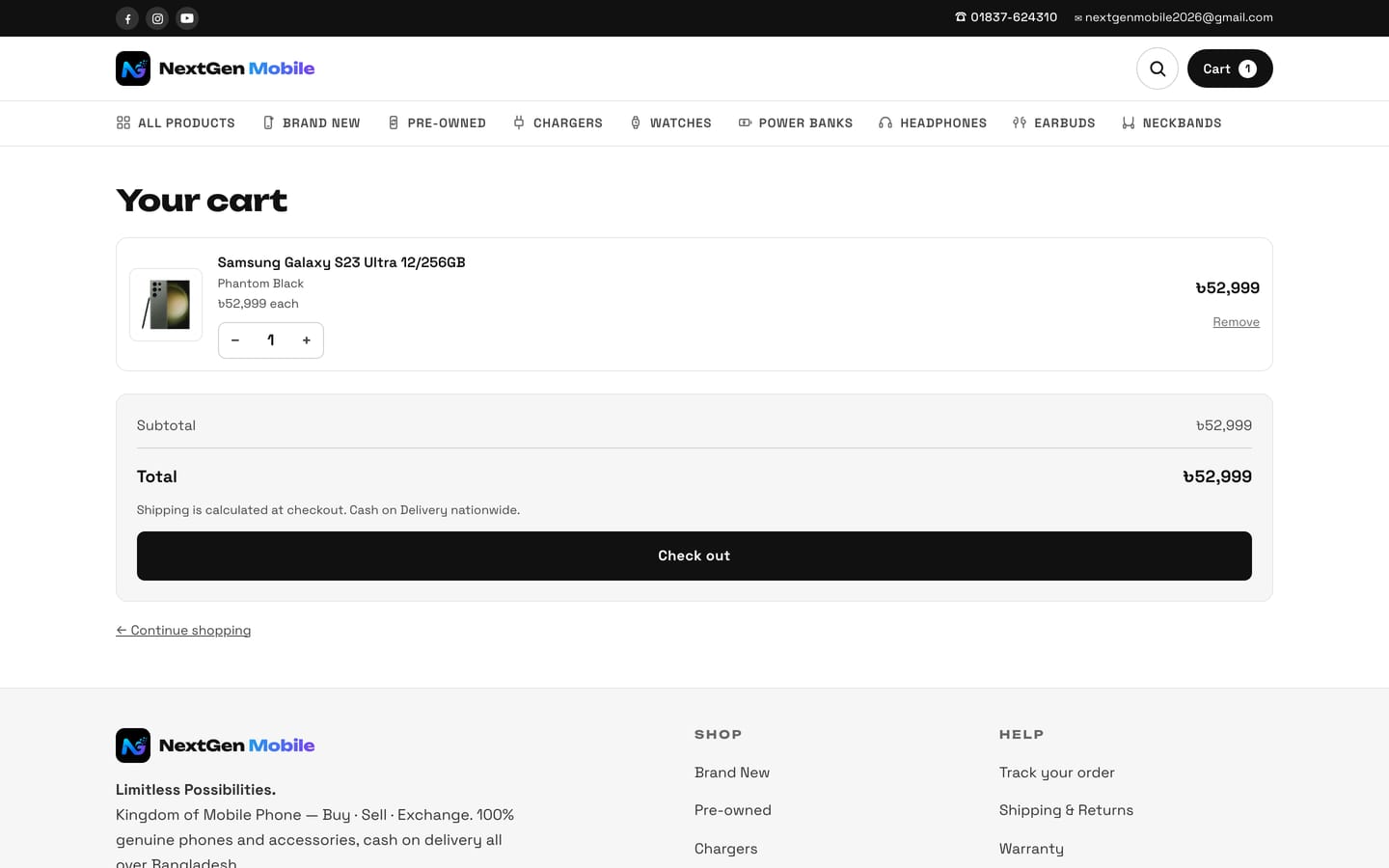
The cart page showing a handset, subtotal and total
Cart

A cart that survives the week

The cart lives in a signed cookie that lasts 14 days, with no account and no database write. Every key and quantity is revalidated against the real catalogue on each read, so a stale or tampered cookie can never produce an order the shop cannot fulfil.

14 day cart, revalidated on every read
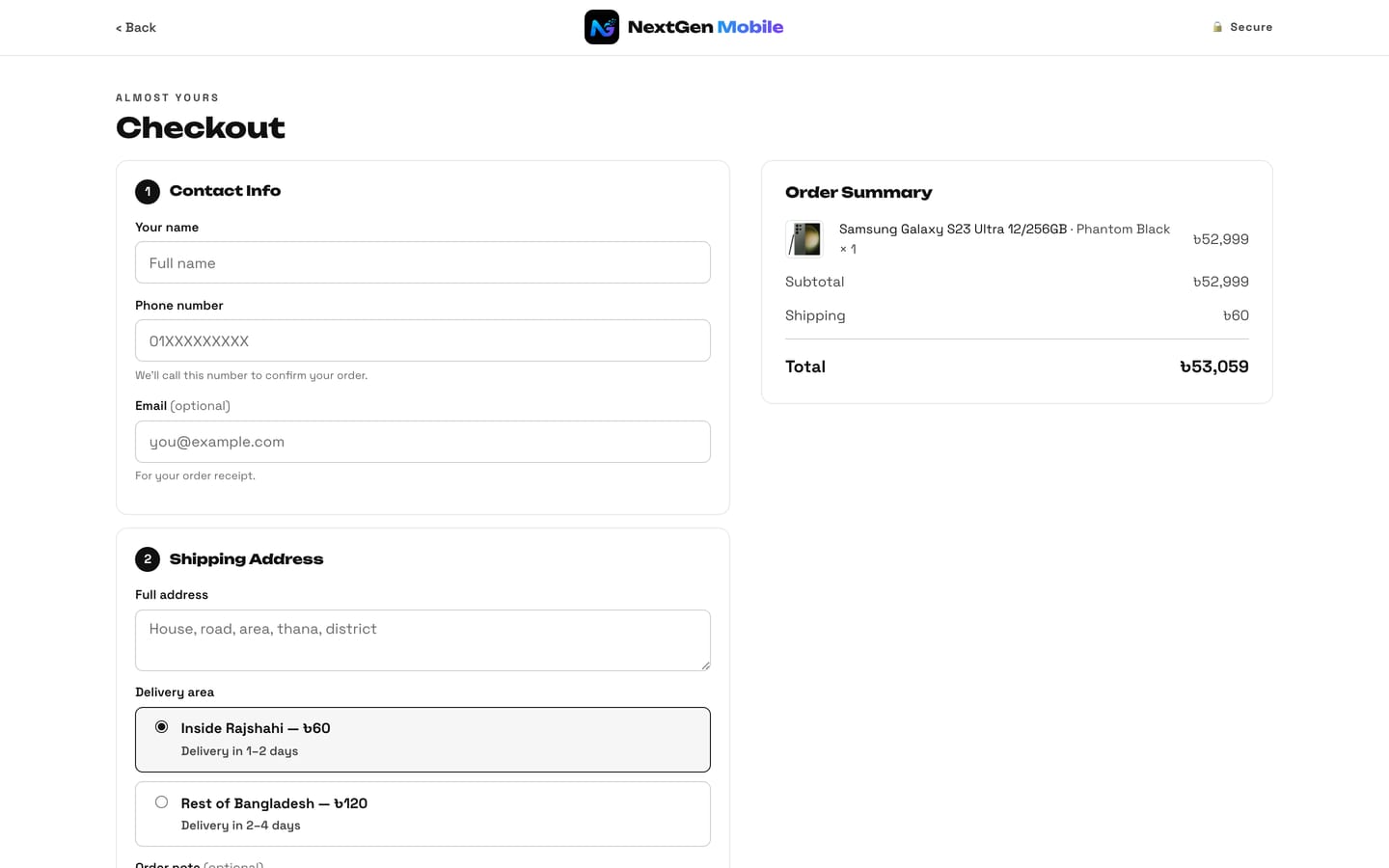
The cash-on-delivery checkout with contact, address and delivery zone
Checkout

Built around cash on delivery, not adapted to it

Navigation is stripped out so there is one path forward. The phone field accepts Bengali numerals and the +880 and 880 prefixes, folding them all to the format the shop can actually dial. Choosing a delivery zone updates the total in place, with amounts grouped the Bangladeshi way.

Bengali numeral input, +880 normalization
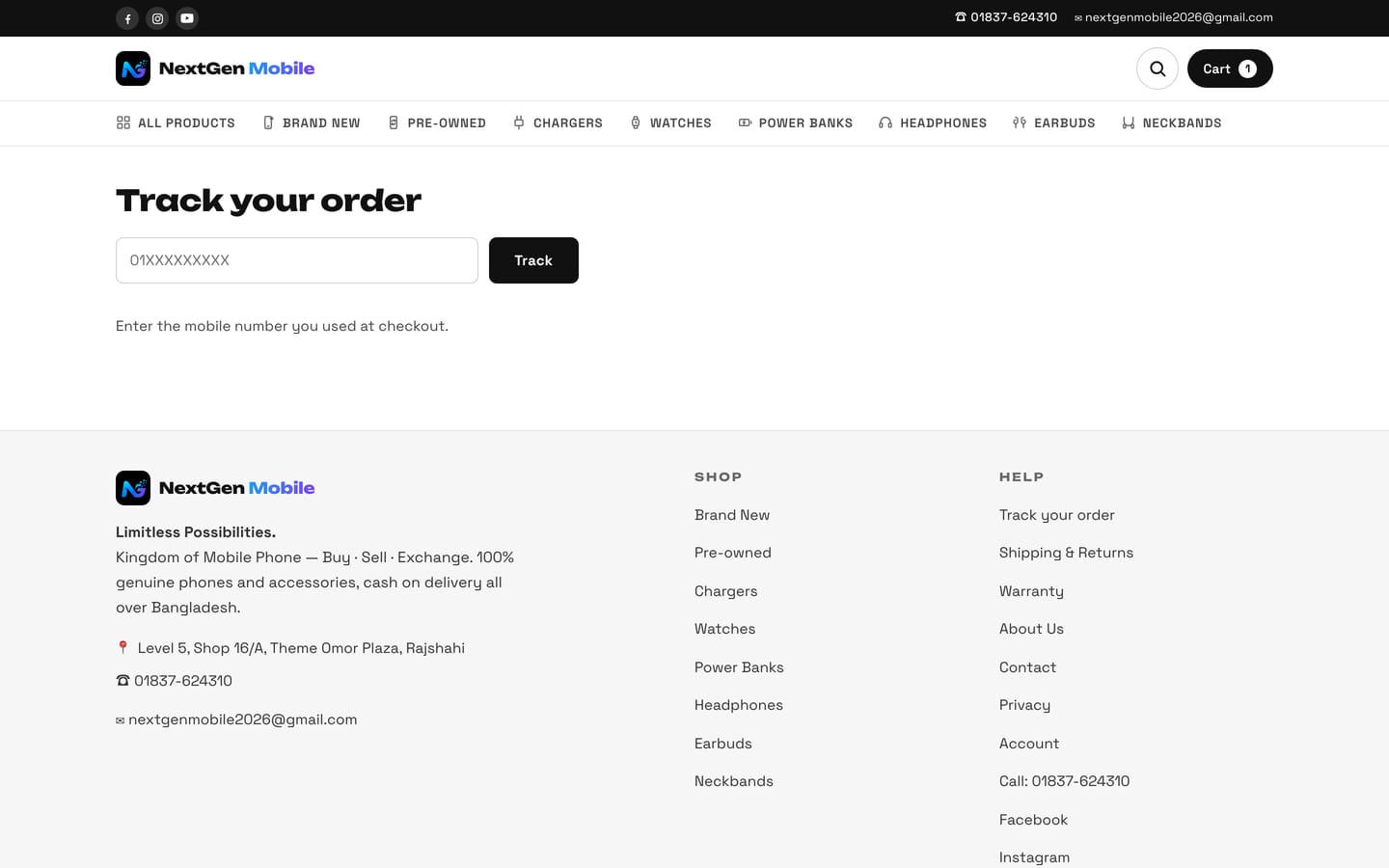
The order tracking page with a phone number lookup
Order tracking

The phone number is the account

Nobody registers, nobody sets a password, and nobody forgets one. A customer enters the number they ordered with and sees their orders, statuses and totals, timestamped in Dhaka time. It removes the single most common reason a customer calls the shop.

No accounts, no passwords, no signup step
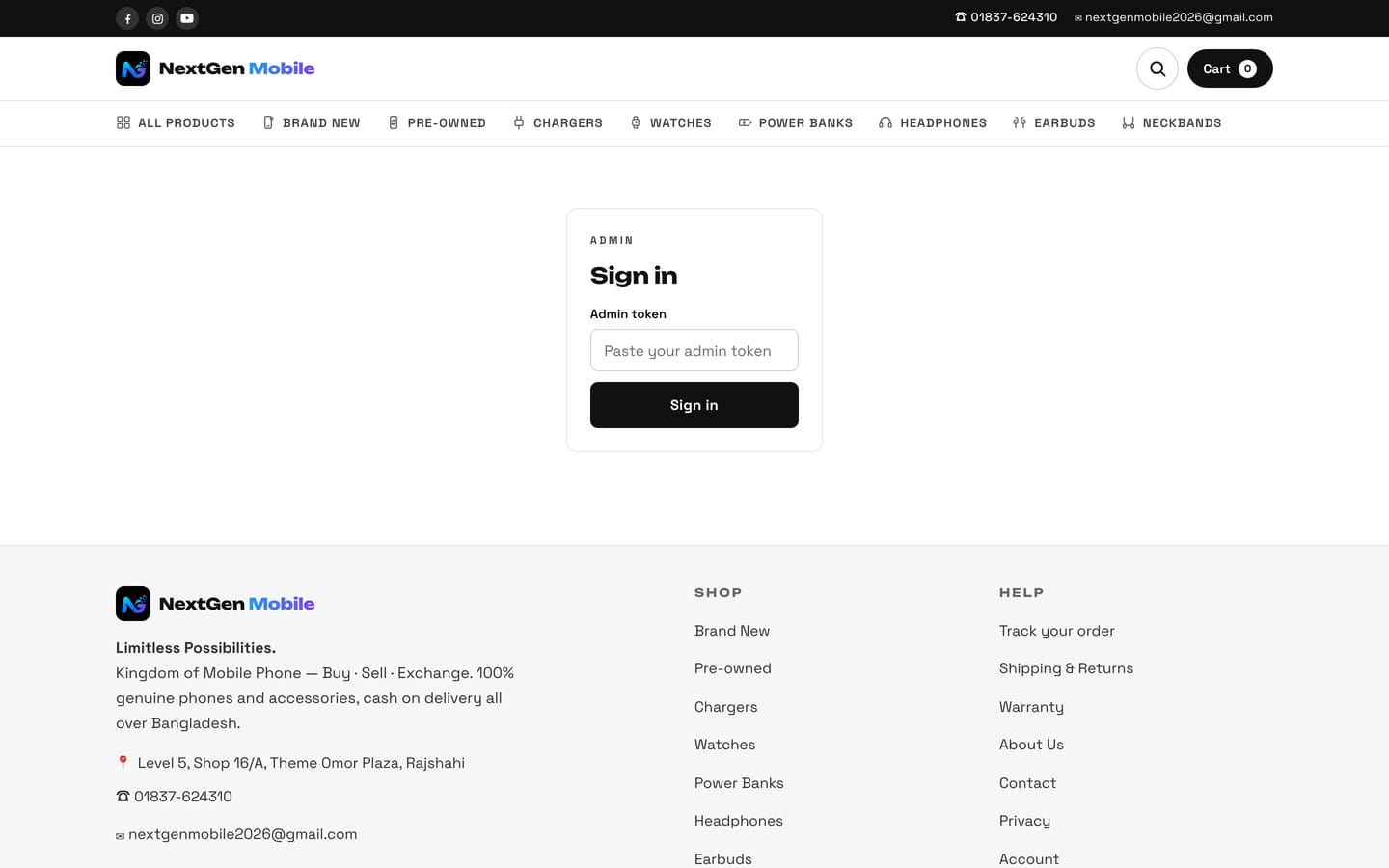
The admin sign-in screen for the order console
Admin

A locked door in front of the order book

The console sits behind a token gate. Tokens are compared in constant time so the check cannot be probed by timing it, the session cookie is scoped to the admin path alone, and every order screen is excluded from search engines. This is the public side of that door.

Constant-time token check, admin-scoped session
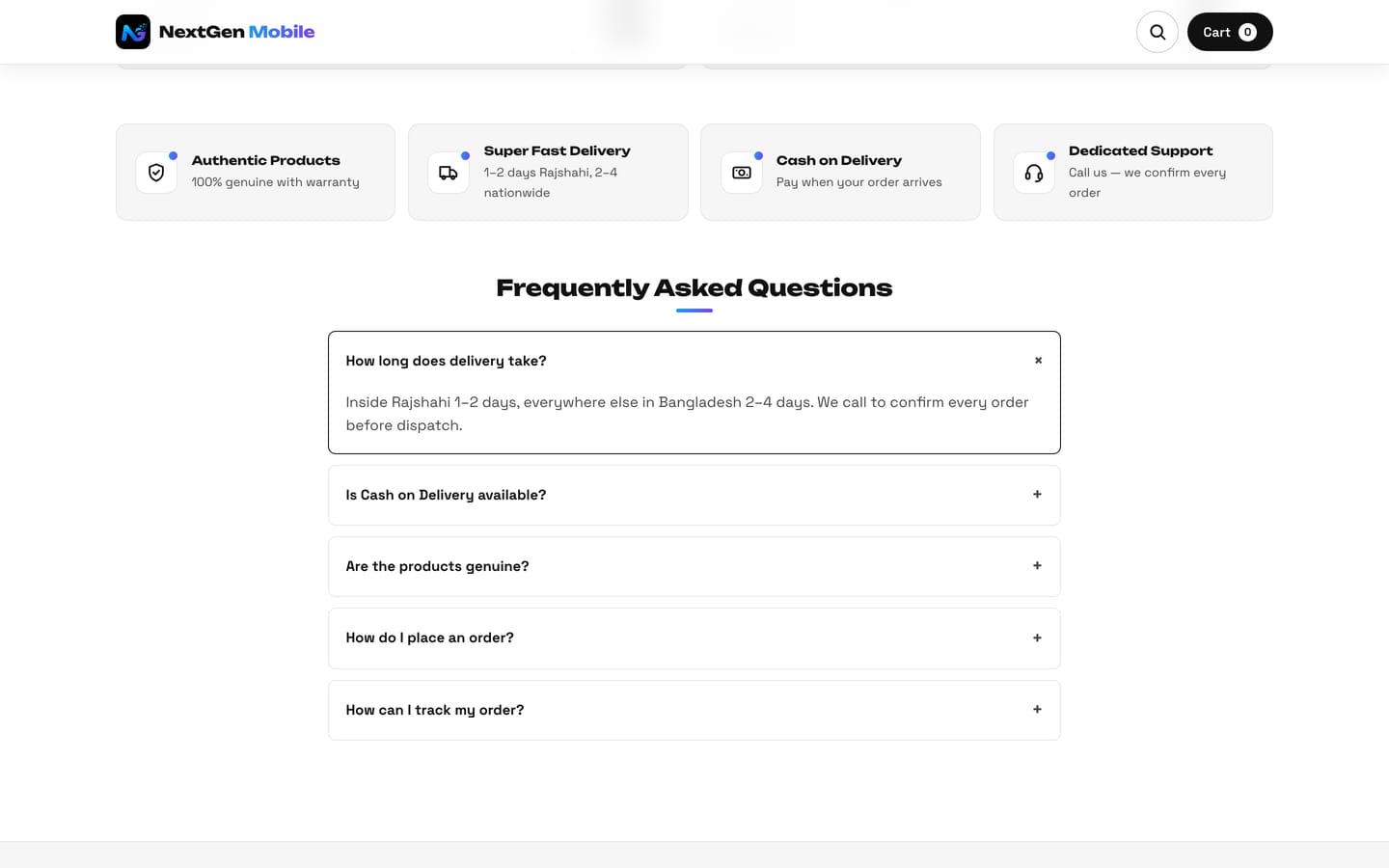
Trust guarantees covering authenticity, delivery speed, cash on delivery and support
Trust

The objection gets answered before it is raised

Buying a used phone from an unfamiliar website is an act of faith. Authenticity, delivery speed, paying on arrival and a human to call are stated plainly on the homepage, because for this category those 4 answers decide the sale long before the specifications do.

4 guarantees, stated on the front page
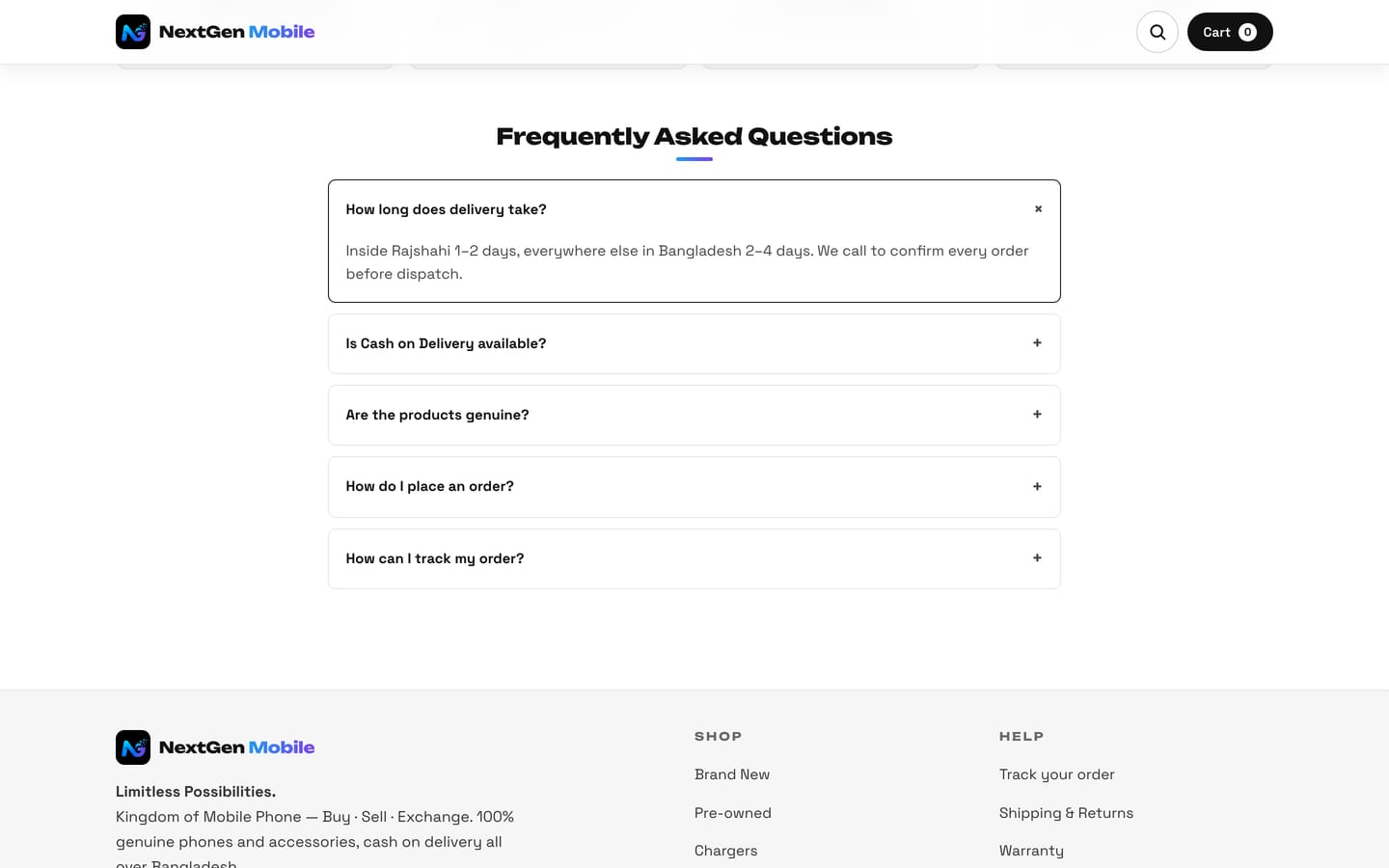
The homepage FAQ accordion covering delivery, payment and authenticity
FAQ

The questions that stall an order, answered on the page

Delivery time, cash on delivery, authenticity, how to order and how to track it. Keeping them on the homepage rather than a policy page means a hesitant buyer resolves the doubt without leaving. The same content is marked up so search engines can read it as questions.

FAQ structured data, no extra page to visit

The client.

NextGen Mobile is a Rajshahi phone retailer built on buy, sell and exchange, trading brand new and pre-owned handsets with 100% genuine stock and cash on delivery anywhere in Bangladesh.

100%Genuine stock
3Ways to trade
2Delivery zones
At a glance

The engagement, on paper.

Client
NextGen Mobile, a mobile phone retailer in Rajshahi, Bangladesh.
Trade
Brand new and pre-owned handsets, plus buy, sell and exchange in store.
Scope
Storefront, catalogue, search engine, cart, cash-on-delivery checkout, order tracking, admin console, and transactional email.
Stack
A single Cloudflare Worker rendering HTML at the edge. No framework and no runtime dependencies.
Data
Cloudflare D1. Orders are the only records stored, so a product view never touches the database.
Search
A custom relevance engine written for this catalogue, not a plugin.
Ownership
The shop owns the code, the orders and the customer data. No platform account sits in the middle.
The challenge

Used phones. Cash on delivery. A Facebook page for a shop window.

Selling handsets online in Bangladesh breaks most of the assumptions built into an off-the-shelf store.

Every used handset is one of a kind

Pre-owned stock has no clean model catalogue behind it. Condition, storage and colour vary unit by unit, and a generic product template flattens exactly the detail a buyer needs.

Cash on delivery puts the risk on the shop

Nothing is paid until a courier is at the door. A wrong number or a vague address is not a support ticket, it is a handset that travelled across the country and came back.

Prices move faster than a catalogue

Handset pricing shifts week to week. Anything that makes a price change slow or awkward means the site is quietly wrong for days at a time.

Demand arrives from social, not search

Customers come from a Facebook page and word of mouth. They land expecting to see stock immediately, not to be introduced to a brand they already know.

Platform fees bite hardware margins

Phone retail runs on thin margins. A monthly subscription and a cut of every sale take a meaningful share of the profit on each handset sold.

Nobody types the official model name

Customers search in a mix of English and Bangla, shorten names, and misspell them. A search box that only matches exact strings returns nothing and loses the sale.

The goals

7 goals, in order.

Agreed before a line of code, and the order matters as much as the list.

01

Put the stock in front of them

A visitor arriving from Facebook should see real handsets and real prices in the first screen, with no brand introduction in the way.

02

Answer the trust question first

Authenticity, delivery and payment on arrival are the decision. State them on the homepage rather than burying them in a policy page.

03

Keep the path to an order short

From landing to a placed order in as few steps as possible, with no account, no password and no page that exists only to collect an email.

04

Match how people actually search

Handle misspellings, shortened names and mixed Bangla and English, because the alternative is an empty results page.

05

Make cash on delivery safe to run

Capture a dialable phone number and a real address at the point of order, so the shop can confirm before anything is dispatched.

06

Give the shop one place to work

Every order in one console, with a status that moves forward and tells the customer automatically when it does.

07

Keep the platform theirs

No subscription, no cut of each sale, and no third party holding the customer list. The shop owns what it paid for.

Our strategy

The decisions behind the build.

Why we built it this way, and what each choice was a trade against.

Render at the edge and keep the catalogue out of the database

The product list is compiled into the Worker itself, so browsing never queries anything. Only checkout, tracking and the admin touch storage. It removes the slowest part of a typical store and the most common thing to fall over under load.

Ship zero runtime dependencies

Nothing from the package ecosystem runs in production. That is a deliberate trade: we wrote more ourselves, and in exchange the shop has no plugin to update, no supply chain to audit, and nothing that breaks because a maintainer pushed a release.

Keep the cart in a cookie, not an account

Requiring registration to hold a cart loses buyers who were 1 tap from ordering. A signed cookie holds it for 14 days with no database write, and every read is revalidated against the live catalogue so it can never be trusted blindly.

Treat the phone number as the account

In a cash-on-delivery market the phone number is already the identity: it is how the shop confirms, how the courier calls, and what the customer remembers. Building accounts on top of that would add a password to forget and nothing else.

Write the search engine instead of installing one

Off-the-shelf search assumes customers type catalogue English. This one handles edit-distance typos, a synonym table of the words buyers here actually use, and Bengali script in the same query. It is more work, and it is the difference between results and an empty page.

Make the shop the owner, not the tenant

On a rented platform the storefront stops the month the billing does, and the customer list belongs to someone else. Building it as owned software means the code, the orders and the data stay with the business.

The commerce engine

What runs underneath.

The systems a customer never sees, and the reason the ones they do see behave.

Catalogue and categories

8 categories with filtering, text query and sorting by price or discount, all expressed as real URLs that can be shared and linked.

Colour variants

A finish is part of the cart line, not a note. The same handset in 2 colours is 2 lines, and the colour follows the order into the confirmation email.

Relevance search

Edit-distance typo tolerance, a domain synonym table, Bengali and English tokenization, and weighted scoring that puts exact matches first.

Cart

A signed 14 day cookie with no database write, capped and revalidated against the live catalogue on every read.

Cash-on-delivery checkout

Bengali numeral input, +880 and 880 folding, address and name validation, and errors returned with every field still filled in.

Delivery zones

Rajshahi and the rest of Bangladesh priced separately, each with its own stated arrival window, recalculating the total as the customer chooses.

Order numbers and price snapshots

Order references are generated from cryptographic randomness so they cannot be guessed or counted, and every line stores the price it was bought at.

Order tracking

A phone number lookup returning orders, statuses and totals in Dhaka time, with no account to create.

Running the shop

How the shop manages it.

4 systems the owner works with, and exactly what each one covers.

01 · The admin console

  • A private order console, reachable only with the shop's admin token
  • Tokens compared in constant time, so the check cannot be probed by measuring it
  • A session cookie scoped to the admin path alone and expiring after 7 days
  • Every order, with customer, items, colour, total and current status on 1 screen
  • Excluded from search engines and from the sitemap by default

02 · The order workflow

  • 5 states covering the real life of an order: pending, confirmed, shipped, delivered, cancelled
  • Status changes from a dropdown that saves on selection, no separate edit screen
  • Orders arrive as pending so nothing dispatches before the shop phones to confirm
  • Each line keeps the price it was ordered at, so a later price change never rewrites history
  • Timestamps rendered in Dhaka time rather than server time

03 · Automated customer email

  • 3 templates: an alert to the shop, a receipt to the customer, and a status update
  • Itemised tables with product thumbnails, totals and a status badge, in HTML and plain text
  • Moving an order to confirmed, shipped, delivered or cancelled emails the customer automatically
  • Sent after the response, so a slow mail provider can never delay a checkout
  • Keyed for idempotency and retried once on a transient failure, so no duplicate receipts
  • A local preview harness renders every template and fails the build on a broken variable

04 · The content layer

  • Products, categories and colour options held in 1 structured catalogue file
  • Banners, promotions and FAQ copy separated out from page code
  • Policy pages kept as their own content, editable without touching layout
  • Adding a product means 1 entry: name, category, price, colours and specifications
  • Sitemap, category pages and structured data all regenerate from that catalogue automatically
The comparison

Renting a store, or owning one.

What the same shop looks like on a subscription platform against the one we built.

Rented platformWhat we built
Running costA subscription every month, indefinitelyNo ecommerce platform subscription
Per saleA percentage of every orderThe full margin stays with the shop
Cash on deliveryAdded on through a pluginThe default the checkout was designed around
Phone numbersGeneric international validationBengali numerals and +880 folded to a dialable number
Delivery pricingBroad zones set by the platformRajshahi and nationwide, priced and timed separately
SearchWhatever the theme ships withA relevance engine written for this catalogue
Page weightA theme plus its plugin stack1 Worker, no client framework, no runtime dependencies
Customer dataHeld inside a platform accountIn the shop's own database
TrackingThird-party pixels by defaultNo third-party trackers at all
OwnershipAccess ends when billing stopsThe code and the data belong to the business
What was built

The platform, by the numbers.

These describe the scope of what was delivered. They are counts from the build, not traffic or revenue figures.

47Crawlable pages
25Handsets listed
0Runtime dependencies
0Third-party trackers
Business impact

What owning it changes.

These describe how the build changes the way the business runs. They are not separately measured outcomes.

The margin stays in the shop

No monthly platform fee and no percentage of each sale, which on thin hardware margins is the difference between a channel that pays and one that does not.

Orders confirm themselves

Every status change emails the customer without anyone remembering to. The shop moves a dropdown and the communication has already happened.

Fewer calls asking where it is

Customers check their own order with the number they ordered on, which removes the most common reason the shop phone rings.

Searches end in a product, not a blank page

A misspelled model name still returns the right handset, so demand that arrives with imperfect spelling still reaches something buyable.

Nothing follows the customer

No advertising pixels and no third-party analytics, so the site carries no tracking baggage and needs no consent banner in front of the stock.

The platform is an asset

The code, the orders and the customer list are the shop's property. Nothing switches off because an invoice went unpaid.

Questions

The short version.

What did Rizer build for NextGen Mobile?

A complete commerce platform, not a theme on top of an existing one:

  • Storefront: homepage, catalogue with filters and sorting, 8 category views, and a product page for every handset.
  • Search: a custom relevance engine with typo tolerance, a synonym table, and Bengali and English tokenization.
  • Buying: a slide-in cart drawer, a signed 14 day cart cookie, and a cash-on-delivery checkout built for Bangladeshi phone numbers and delivery zones.
  • After the order: phone-number order tracking, and 3 transactional email templates covering the shop alert, the customer receipt, and status updates.
  • Operations: a token-gated admin console with a 5 state order workflow.
Why not just use Shopify or WooCommerce?

They are good products. They are a poor fit for this particular shop:

  • The cost lands in the wrong place: a monthly fee plus a cut of each sale is painful against handset margins.
  • Cash on delivery is an afterthought: both are designed around card payment, with COD added through a plugin rather than assumed.
  • The local details are wrong by default: Bengali numeral input, +880 handling, Bangladeshi digit grouping and Rajshahi delivery zones all need working around.
  • Search cannot be fixed: platform search matches strings, and this catalogue needed a relevance model of its own.
  • The honest trade: a custom platform costs more to build and needs a developer to add a product. In exchange there is no rent, no transaction cut, and no landlord.
How does cash on delivery work on the site?

Nothing is charged online. The site's job is to capture an order the shop can safely dispatch against:

  • A dialable number: Bengali numerals and the +880 and 880 prefixes are folded into a single valid Bangladeshi mobile format before the order is accepted.
  • A real address: name, address and delivery area are validated at checkout, and errors come back with every field still filled in.
  • A zone and a timeframe: Rajshahi and the rest of the country are priced separately, each with its own stated arrival window, and the total updates as the customer chooses.
  • Confirmation before dispatch: orders arrive as pending, and the shop phones to confirm before anything is sent.
How does the shop manage orders day to day?

Through a private console, in a single screen:

  • Getting in: an admin token, compared in constant time, with a session scoped to the admin path and expiring after 7 days.
  • The order book: every order with customer, items, colour, total and status listed together.
  • Moving an order on: 5 states from pending to delivered or cancelled, changed from a dropdown that saves on selection.
  • The customer is told automatically: confirmed, shipped, delivered and cancelled each send a branded email without anyone writing one.
  • Adding stock: products are held in a structured catalogue and published by us, so a new handset is a request to Rizer rather than a form in the console.
Can Rizer build this for my shop?

Yes, and this is the model we would recommend for most product businesses selling locally:

  • Best fit: shops with real margin pressure, a cash-on-delivery or local-payment market, and enough order volume that platform fees are noticeable.
  • What you get: the storefront, the checkout, the order system and the admin, built around how your market actually buys.
  • What you own: the code, the orders and the customer data, on infrastructure in your own name.
  • What to weigh: a custom platform is a larger upfront build than installing a theme, and it pays back through fees you stop paying.
  • Next step: book a free call and tell us what you sell.
Keep exploring

More case studies.

View all
Your turn

Paying rent on your own storefront? You do not have to.

If platform fees and transaction cuts are eating the margin on every sale, a platform you own pays for itself and then keeps paying.