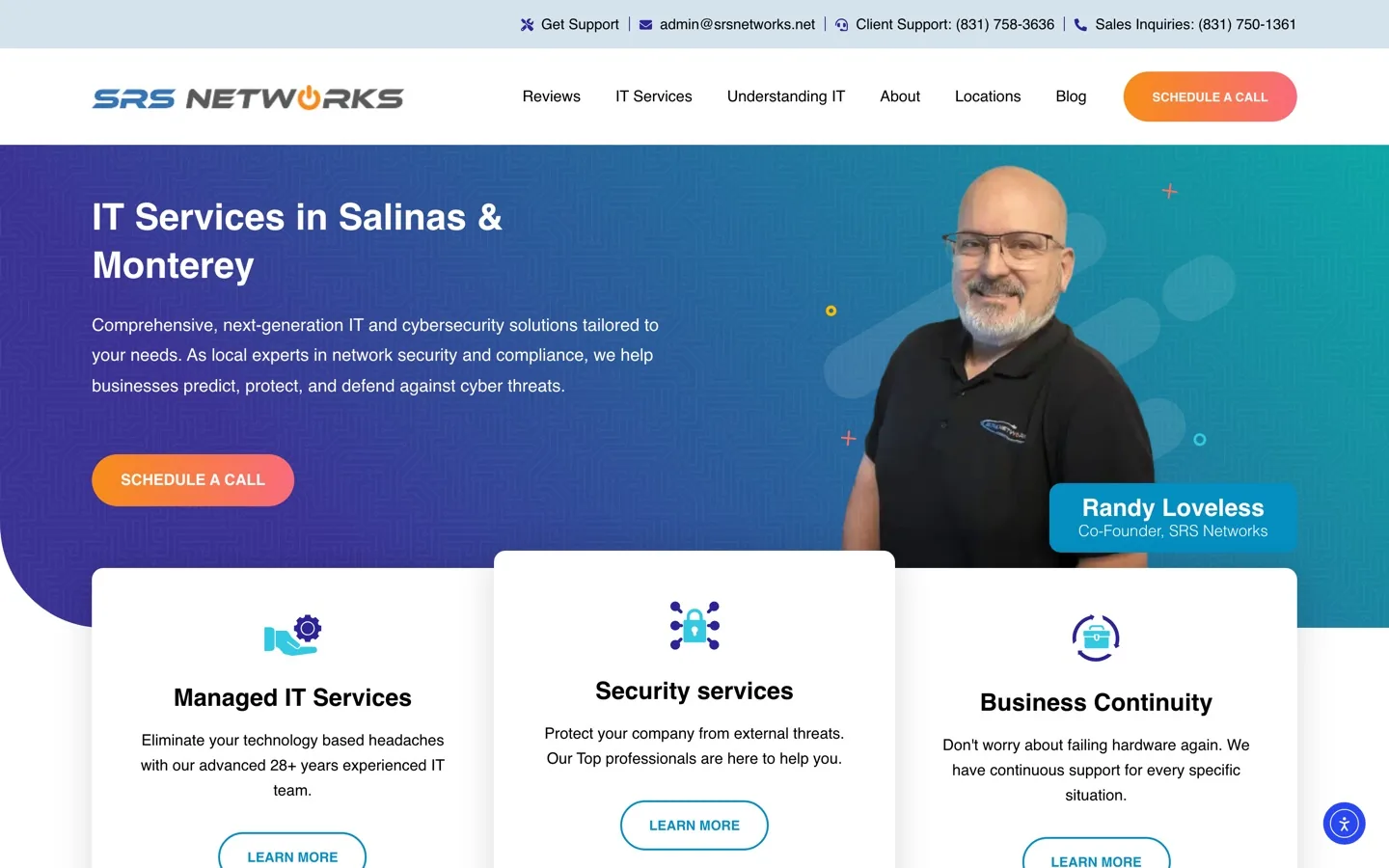
A page for each service category
Group your catalogue into categories a business owner recognises, such as managed IT, security, cloud, hardware, software and communications. Each category gets its own page, written around the search a buyer types.
Get a website for your IT company or managed service provider with a page for each service, a page for each city you serve and a call booking form on every page. SRS Networks, a 28-year managed IT and cybersecurity provider in Salinas and Monterey, California, reported roughly 3x the website visitors 6 months after its rebuild.
Updated 27 October 2026
| What you get | Service and category pages, city pages, trust sections, a client support route, booking forms and on-page SEO |
|---|---|
| Timeline | About 2 to 4 weeks for a full website; local SEO grows over 3 to 6 months |
| Platforms | WordPress, Webflow or custom code, with reusable templates for new service and city pages |
| Suits | Managed service providers, IT support firms and cybersecurity companies that sell in several towns |
| To start | Your service list, the towns you cover and the reviews, partners and awards you already have |
| Proof | SRS Networks: roughly 3x the website visitors 6 months after relaunch, as reported by the client |
Business owners compare several IT providers before they book a call. Your site has to show what you cover, where you work and why you can be trusted, then make the next step obvious.
Group your catalogue into categories a business owner recognises, such as managed IT, security, cloud, hardware, software and communications. Each category gets its own page, written around the search a buyer types.
Give network security, threat management and email protection their own indexed page. Cybersecurity is the search that brings the most urgent buyers, so it should not sit inside a general services list.
Each market gets its own written page with local details, service-area references and a booking form. Every city page links to the matching services, so visitors and search engines can follow the structure.
Show your years in business, a named and pictured founder, your technology partners, awards and reviews. Buyers look for this proof before they let a new provider near their systems.
Make Schedule a Call the main action in the header, hero, content sections and footer. Back it with a contact form and direct sales lines for slower enquiries.
Give current clients a Get Support link, support phone and email, a ticket portal and remote support. Prospects then get a clean booking path without support traffic in the way.
These are the changes the SRS Networks rebuild made, moving from an early-2000s brochure site to a structured lead site.
| Compare | Brochure IT website | Site built for MSP leads |
|---|---|---|
| Services | A long list of services with no structure | 6 clear categories with cards, subpages and industry paths |
| Towns served | 1 generic page expected to rank everywhere | A written page for each market, linked to the matching services |
| Credibility | The company looks smaller online than it is | Founder, history, partners, reviews and awards visible |
| Next step | Visitors browse and leave without booking | Schedule a Call repeated on every page with a booking form |
| Existing clients | Support requests mixed into the sales pages | A separate support route with phone, email, tickets and remote help |
| Search reach | Limited reach beyond people who already know the name | Service, industry, city and educational pages that each target a search |
| Adding pages | No structure for adding new service or city pages | Reusable templates for new cities, services and industries |
If your company is better than its website and you sell across several towns, choose the structured site built around booked calls.
SRS Networks has served Salinas and Monterey since 1996 and was running an early-2000s website that under-represented a business with 1,000+ customers. The rebuild ran across 6 workstreams on WordPress: roughly 60 services grouped into 6 categories, a dedicated cybersecurity page, industry pages for 6 sectors, an education hub, 10 individually written city pages, founder and partner trust sections, a separate support route for clients, and Schedule a Call as the single primary action. Local citations and niche-relevant backlinks ran alongside it. 6 months after relaunch, SRS Networks reported roughly 3x the website visitors and significantly improved local rankings.
From the first call to a website that brings booked calls, in 6 steps.
You explain your services, the towns you cover and how clients book you today, and a quote follows the call.
Your service catalogue is audited and grouped, and the sitemap of service, industry, city and support pages is agreed.
A custom design in your brand that puts your location, experience and core services in the first screen, laid out for phones first.
Responsive development on WordPress, Webflow or custom code, with booking forms, support links and on-page SEO on every page.
Launch and QA, speed and SEO checks, and every booking form and support route tested before the site goes live.
Local SEO, city pages and backlinks continue for 3 to 6 months, with a clear monthly report.
Rizer has no price list. Your quote is built from the scope below and follows the free 15-minute call.
Benni Klein, Owner, Accessible Trip Brazil
The cost depends on how many services, industries and city pages your site needs, and whether SEO runs after launch. Rizer has no price list. You get a quote after a free 15-minute call, which you can book here.
A full website is ready in about 2 to 4 weeks. Local SEO and content grow over 3 to 6 months; SRS Networks reported roughly 3x the website visitors after a 6-month SEO period.
Yes, each main service category should have its own page. Buyers search for a specific service such as cybersecurity or cloud, and a dedicated page can be written for that search. SRS Networks grouped roughly 60 services into 6 category pages with subpages beneath them.
Yes, if you sell in several towns, each town needs its own written page. A single page asked to rank in every town ranks well in none of them. SRS Networks has 10 city pages, from Salinas and Monterey to San Jose, each linked to the matching services.
Yes, give existing clients their own support route. A Get Support link, support phone and email, a ticket portal and remote support keep clients out of the booking path, so prospects see 1 clear next step.
WordPress, Webflow and custom code all work; the choice depends on who will edit the site and how many pages you plan to add. SRS Networks runs on WordPress with reusable page templates, so new city, service and industry pages are added without a rebuild. Compare the options in the WordPress vs Webflow vs custom code guide.
Yes, when every indexed URL is mapped and redirected before the new site goes live. Rizer plans the migration before the design starts, the same method used to move Rio Day Trip to a new platform without losing its search rankings. See website redesign and migration.
Yes, 1 team handles the design, development, SEO and Google Ads. You can book the rebuild only, SEO only, or both as 1 connected programme. See local SEO and Google Ads.
Send your service list and the towns you cover, and get a plan and a quote after a free 15-minute call.