Speaking is the module everyone skips
It needs a prompt, a voice, a recording, and a examiner-style judgement. Most platforms either omit it or post static cue cards, which is the module students most need to rehearse.
Most online IELTS sites are question banks that quietly skip Speaking. We built IELTS Test BD as a complete testing platform: all 4 skills, browser-recorded Speaking with AI transcripts and band estimates, work that survives a dropped connection, and an admin workspace that runs the whole centre.


15 pieces of the platform, from the public page a student lands on to the workspace the centre runs it from.
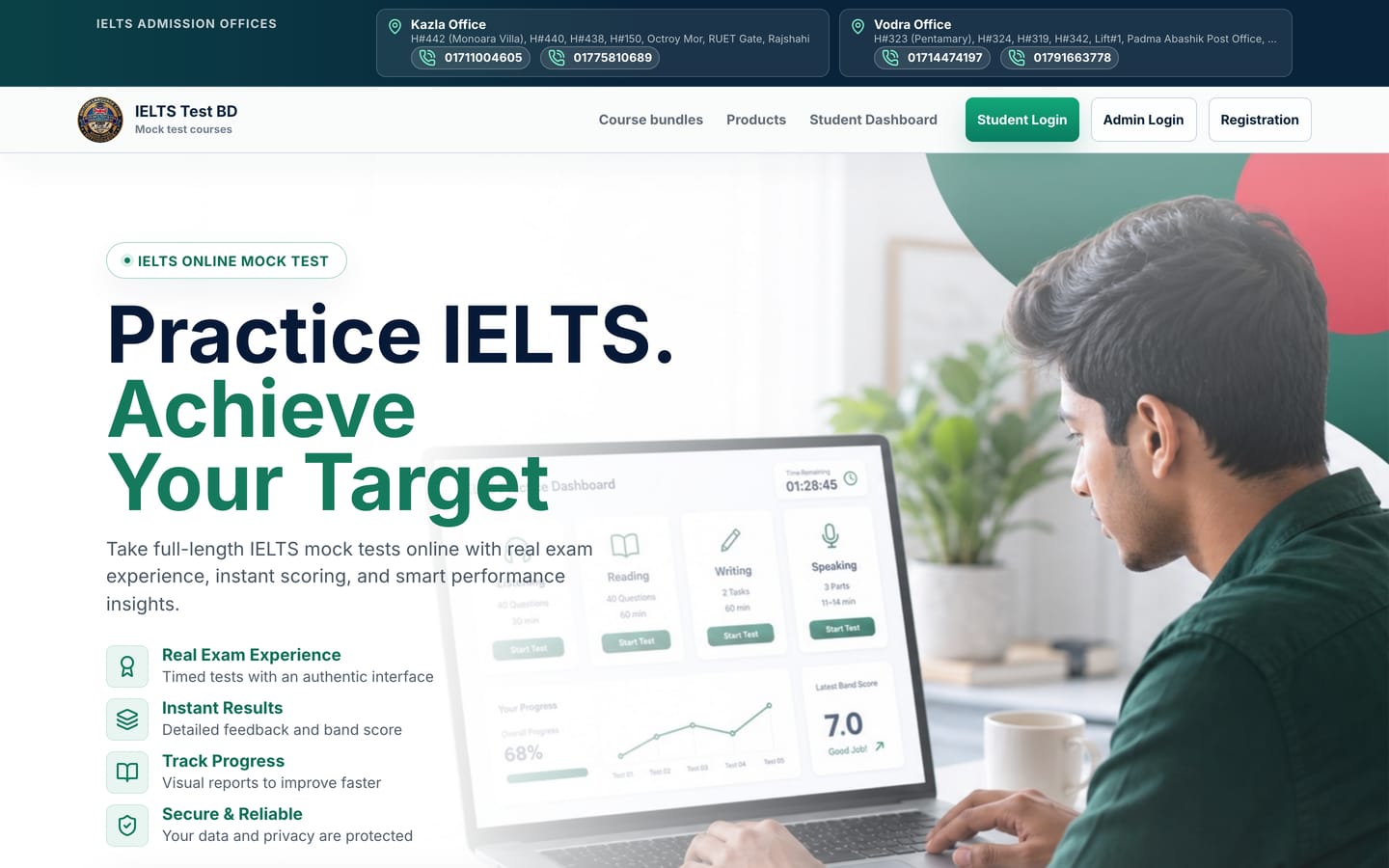
Real exam experience, instant results, progress tracking and data security, stated on the first screen with a live view of the product behind them. The admission office numbers sit in a strip above the navigation, because a large share of this audience still decides by phoning the centre.
Office contact above the fold on every page
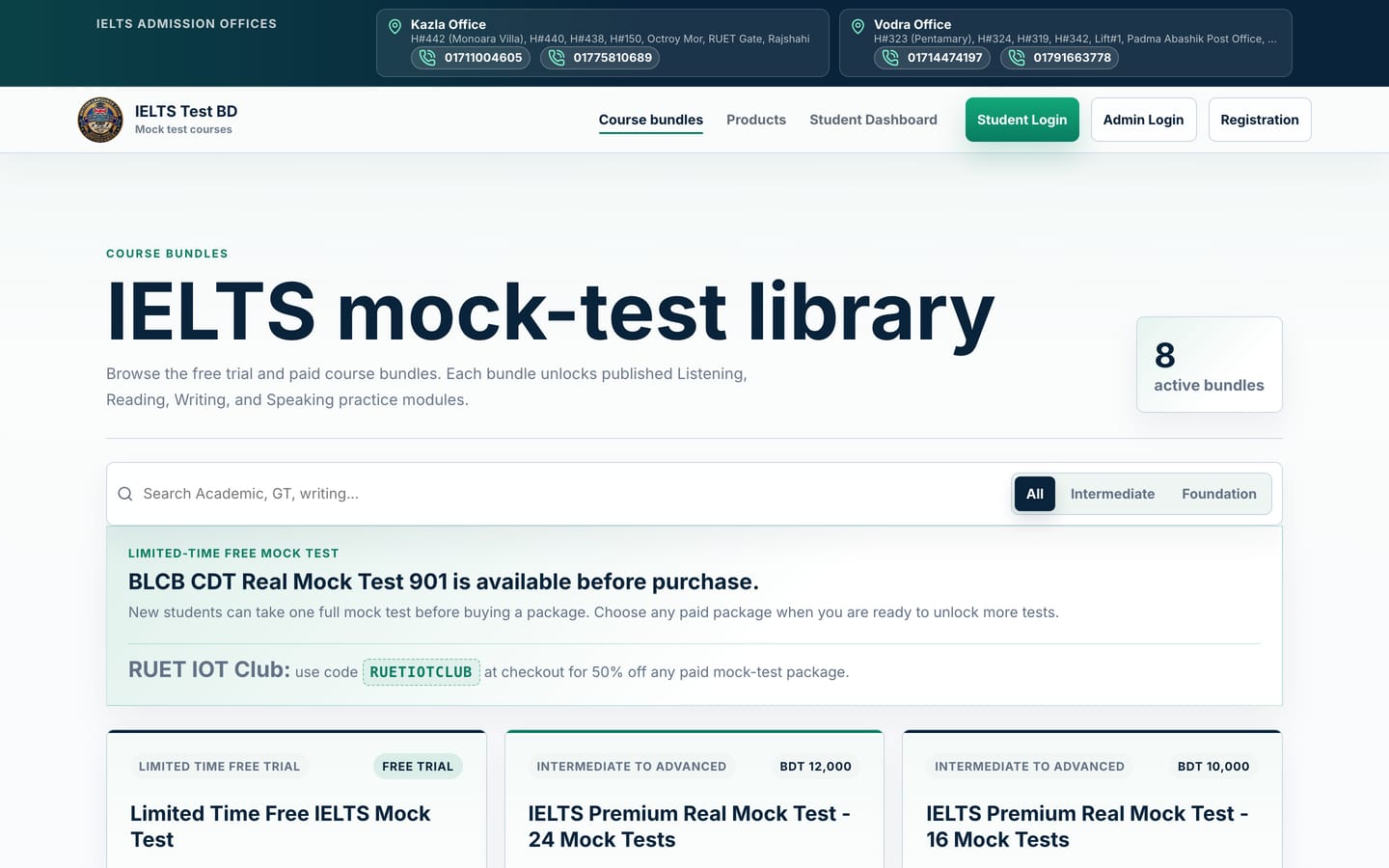
8 active bundles from a free trial through to 24 mock tests, each one searchable and filterable by level. A free full mock sits at the top of the list on purpose, so a student can complete a real test before being asked to pay for anything.
Free full mock available before purchase
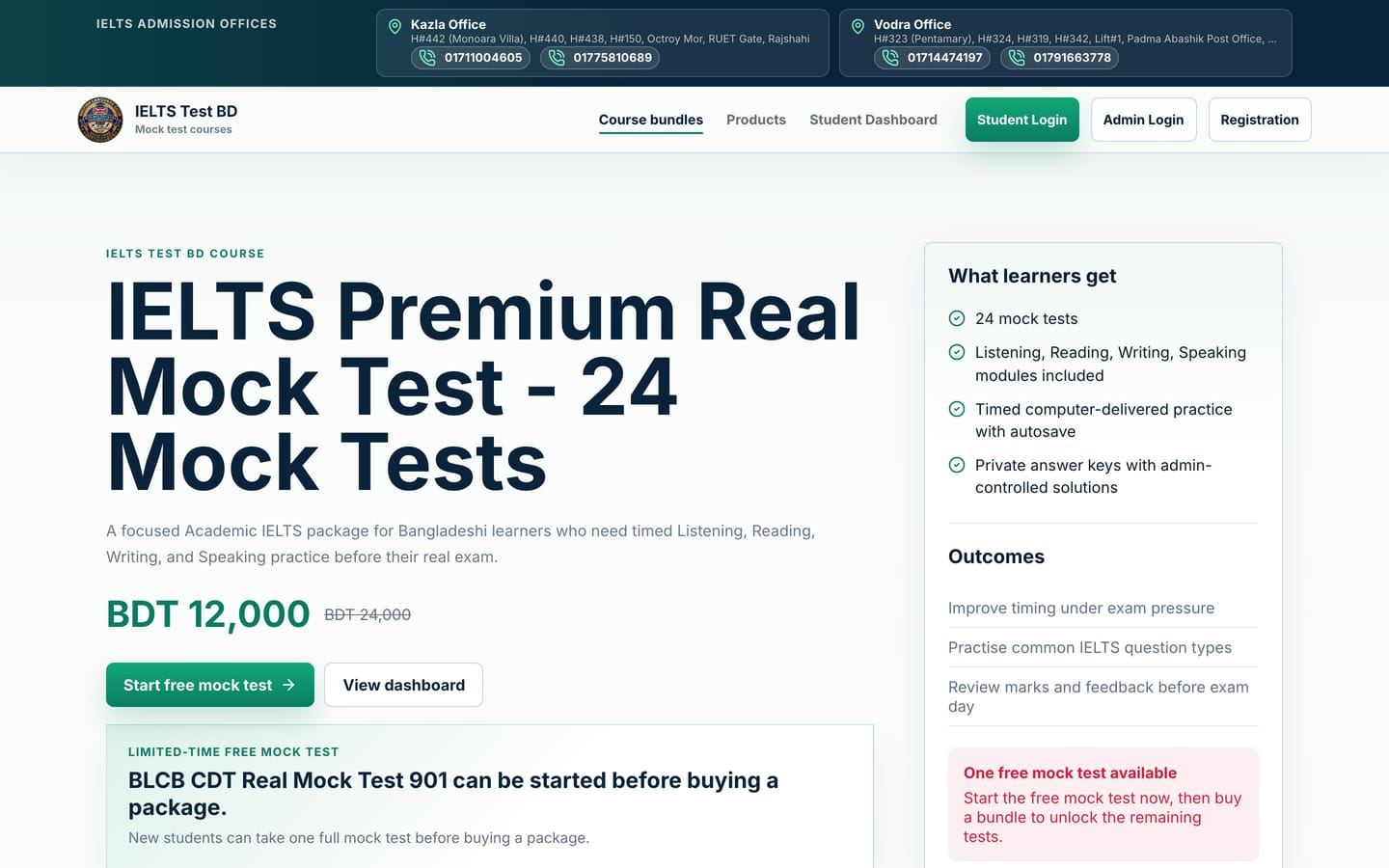
Each bundle separates what is included from what the student should be able to do afterwards. Pricing shows the list price against the current price, and a promo code applied at checkout is validated on the server rather than trusted from the browser.
Discounts calculated server-side, never client-side
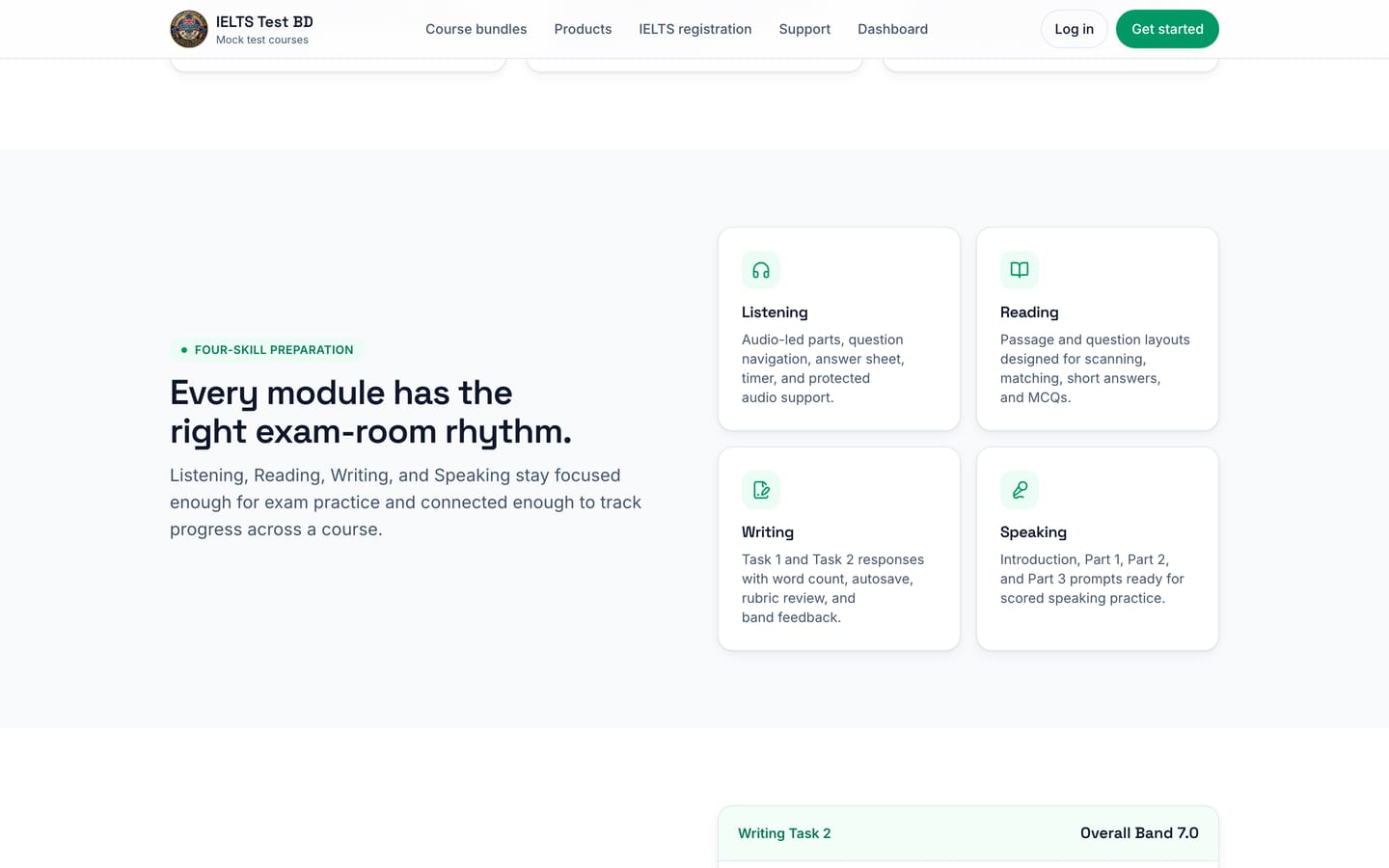
Listening runs on audio-led parts with protected playback. Reading uses passage layouts built for scanning and matching. Writing carries word counts and rubric review. Speaking runs Introduction plus Parts 1, 2 and 3. They stay distinct where the exam is distinct, and connected where progress needs to add up.
4 modules, 1 progress record
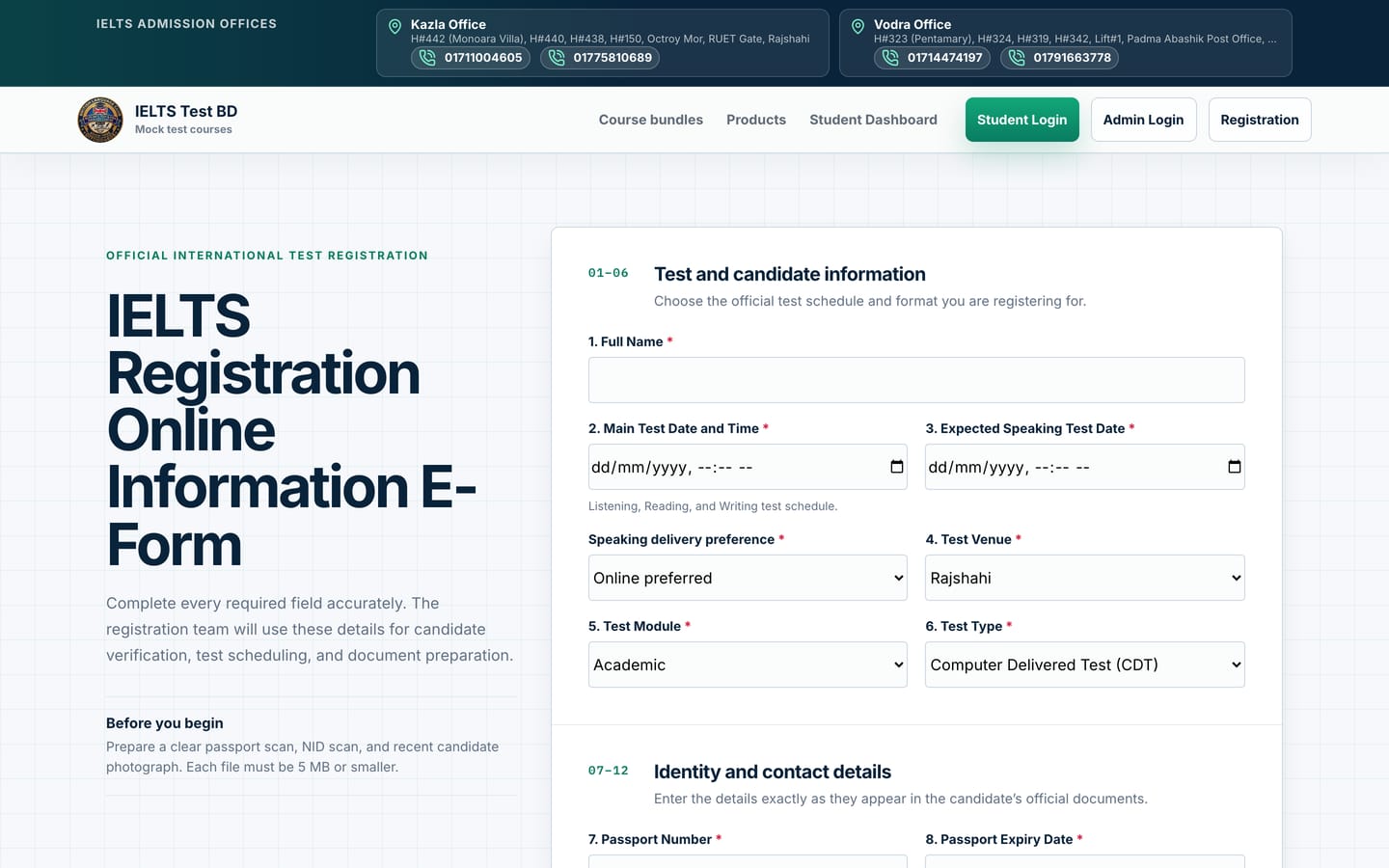
Beyond mock tests, the centre registers candidates for the real IELTS exam. This form collects test date, venue, module, delivery type, passport and NID details, destination countries and document scans, then generates a reference number and lands in an admin inbox with the uploads attached.
Identity documents stored in private storage
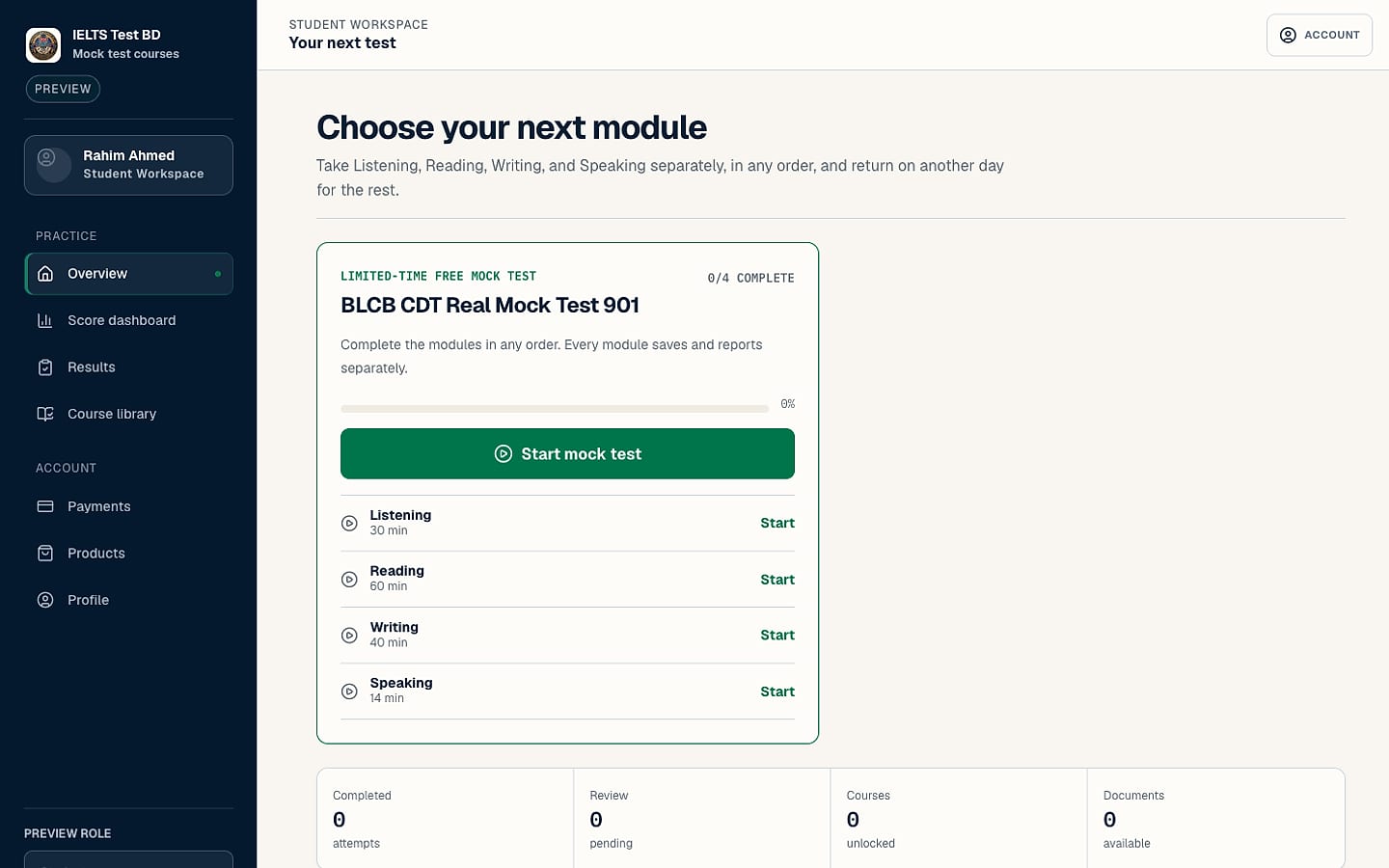
The mock card carries all 4 modules as compact rows, each showing Start, Resume or Result depending on where the student actually is. The main action changes with them, so a returning student is 1 tap from the right place instead of navigating a menu to find it.
Action label follows the real attempt state
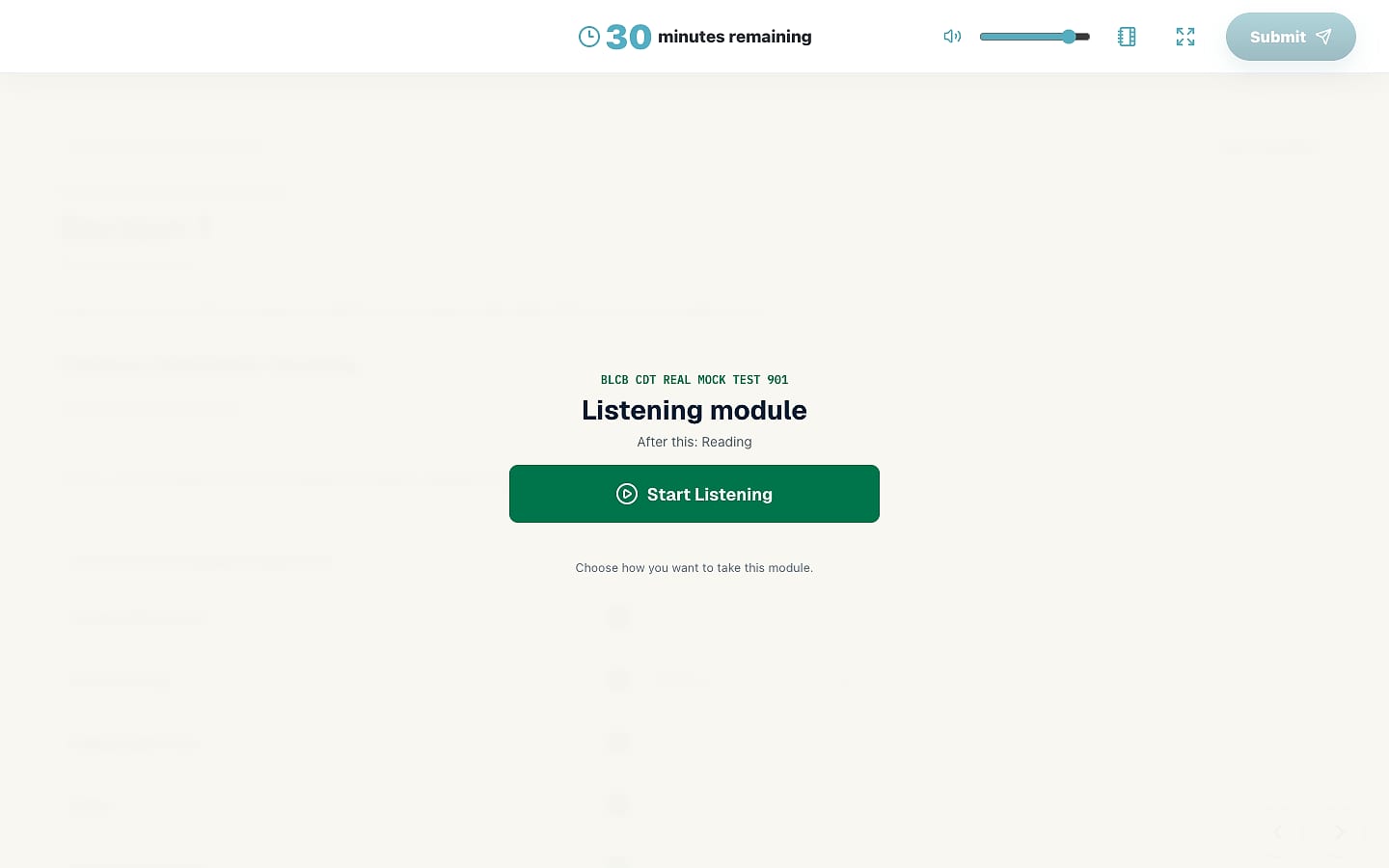
A student is never forced to sit a full mock in one session. Listening today and Speaking on Saturday is a supported path, and each module scores and reports on its own. Once all 4 are complete the platform calculates the overall band from them.
Modules scored separately, band combined at the end
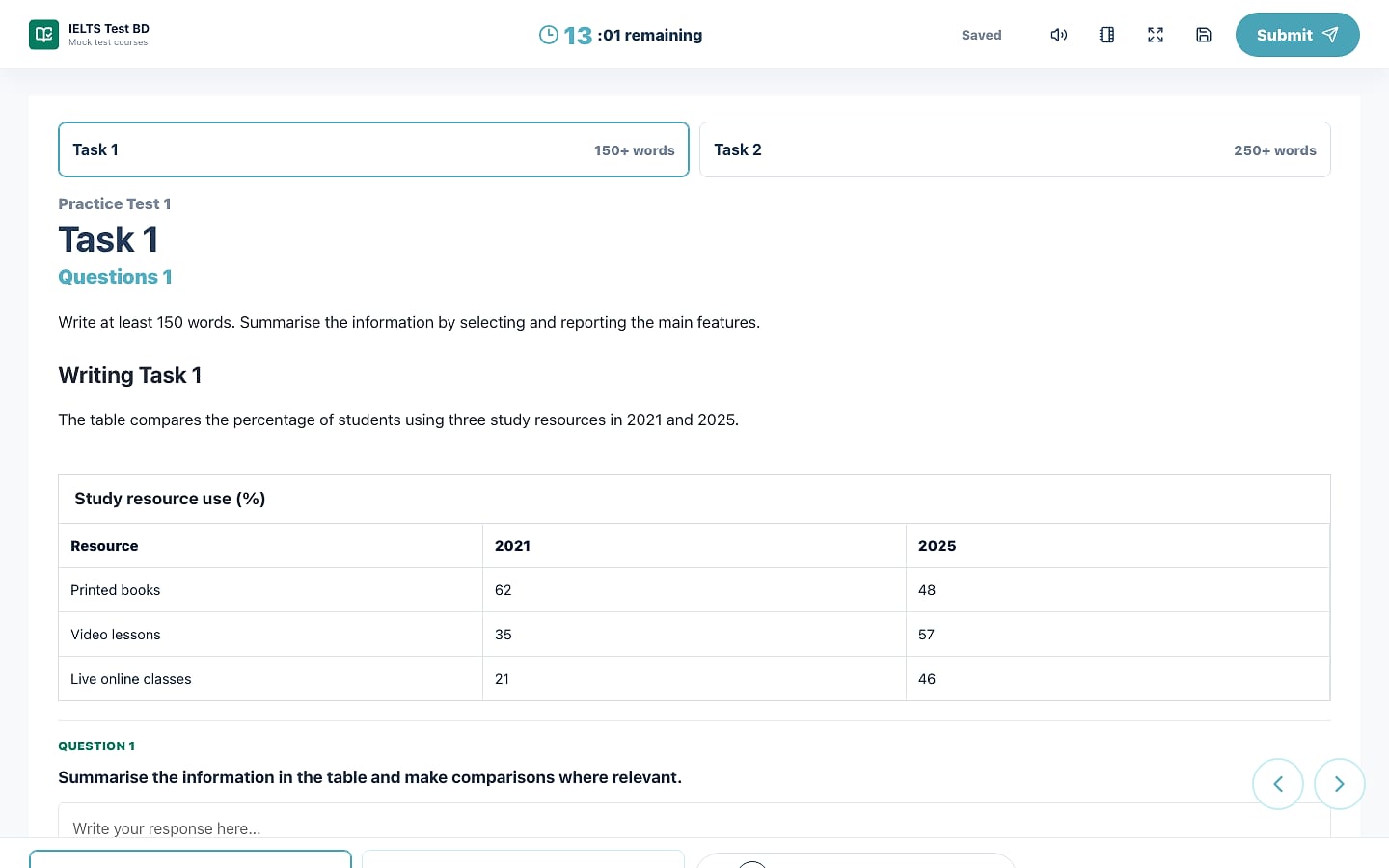
Note the timer, the word targets on each task tab, and the word "Saved" in the toolbar. Answers save to the server as the student writes, and a local draft is written before the network call even completes. Reopen the test and it restores the exact question, the notes, the mode and the remaining time.
Server autosave plus a local draft, merged by timestamp
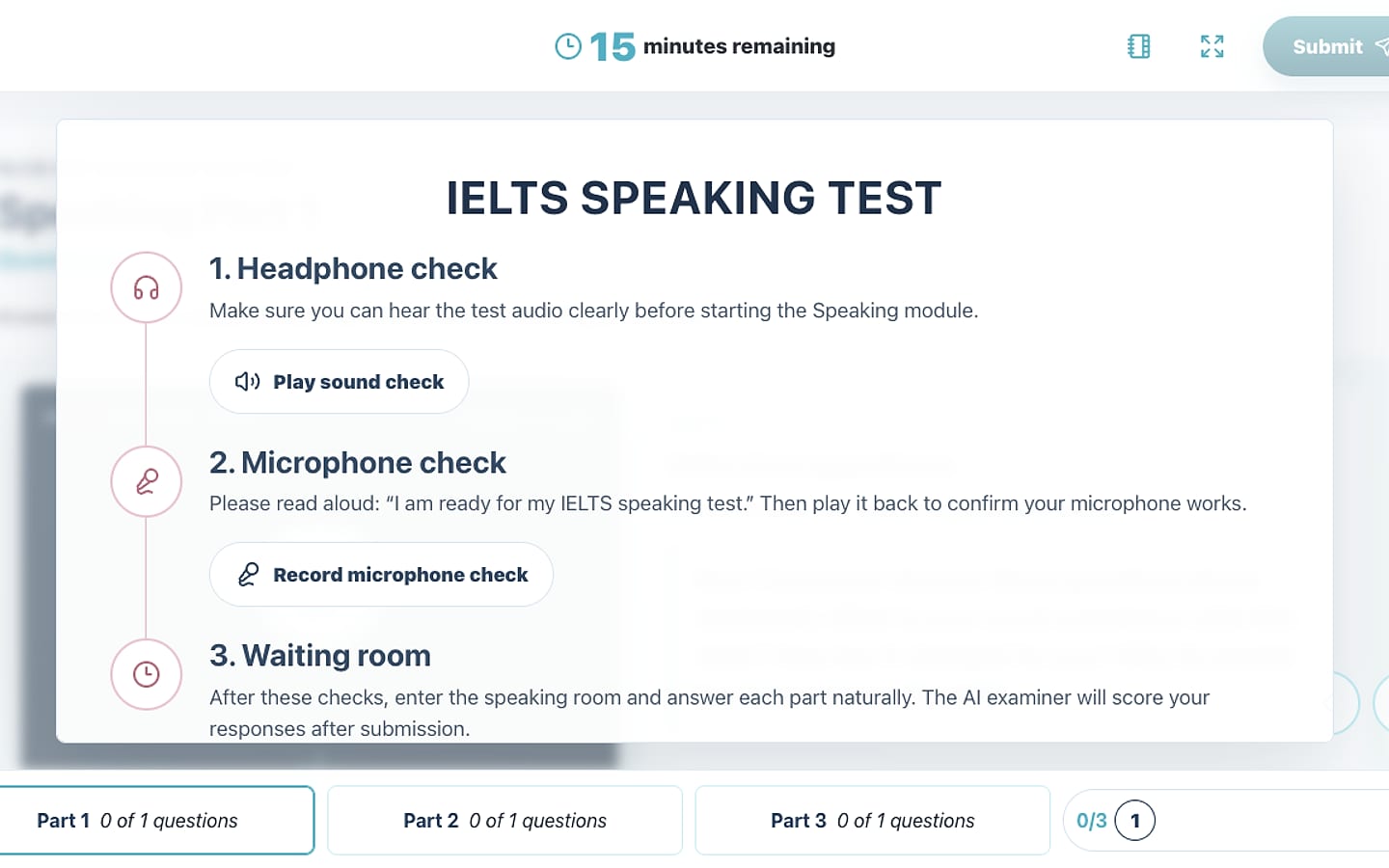
Speaking opens with a headphone check, a microphone check and a waiting room, so a student finds out their audio is wrong before the test rather than after it. Then they answer each part aloud in the browser. The checks guide without trapping: a student who wants to proceed can.
Audio verified before the attempt, not after
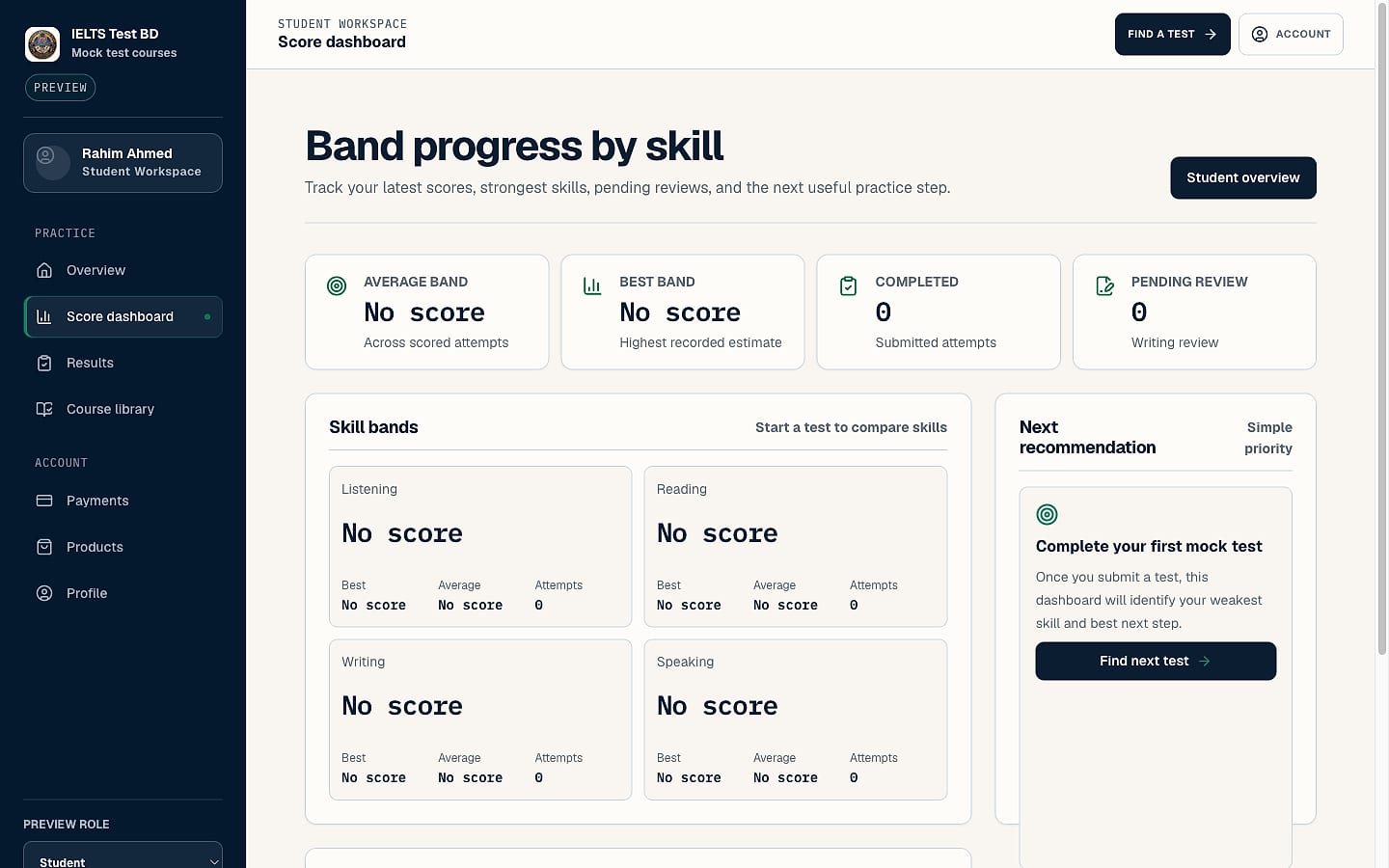
Average band, best band, completed attempts and pending reviews across the top, then a panel per skill holding best, average and attempt count. Alongside it sits a recommendation that names the single most useful next test, so a student is not left to interpret their own weakest area.
Weakest skill drives the next recommendation
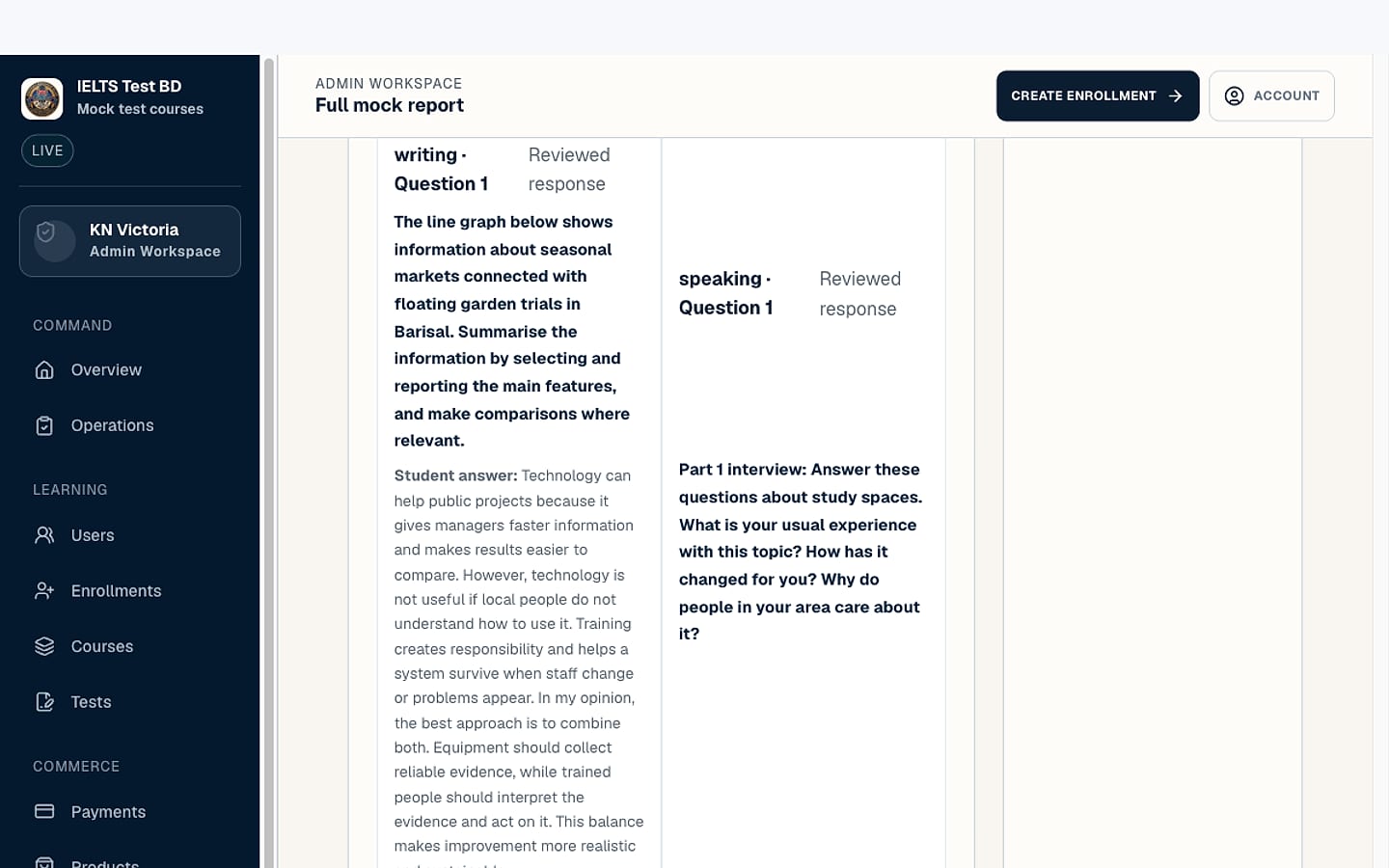
Listening, Reading, Writing and Speaking are grouped under the parent mock, with a band for each skill and an overall band rounded to the nearest half. Objective questions show the student's answer beside the correct one with an explanation. Writing and Speaking show rubric feedback and, for Speaking, the transcript of what was said.
Answers released only after submission
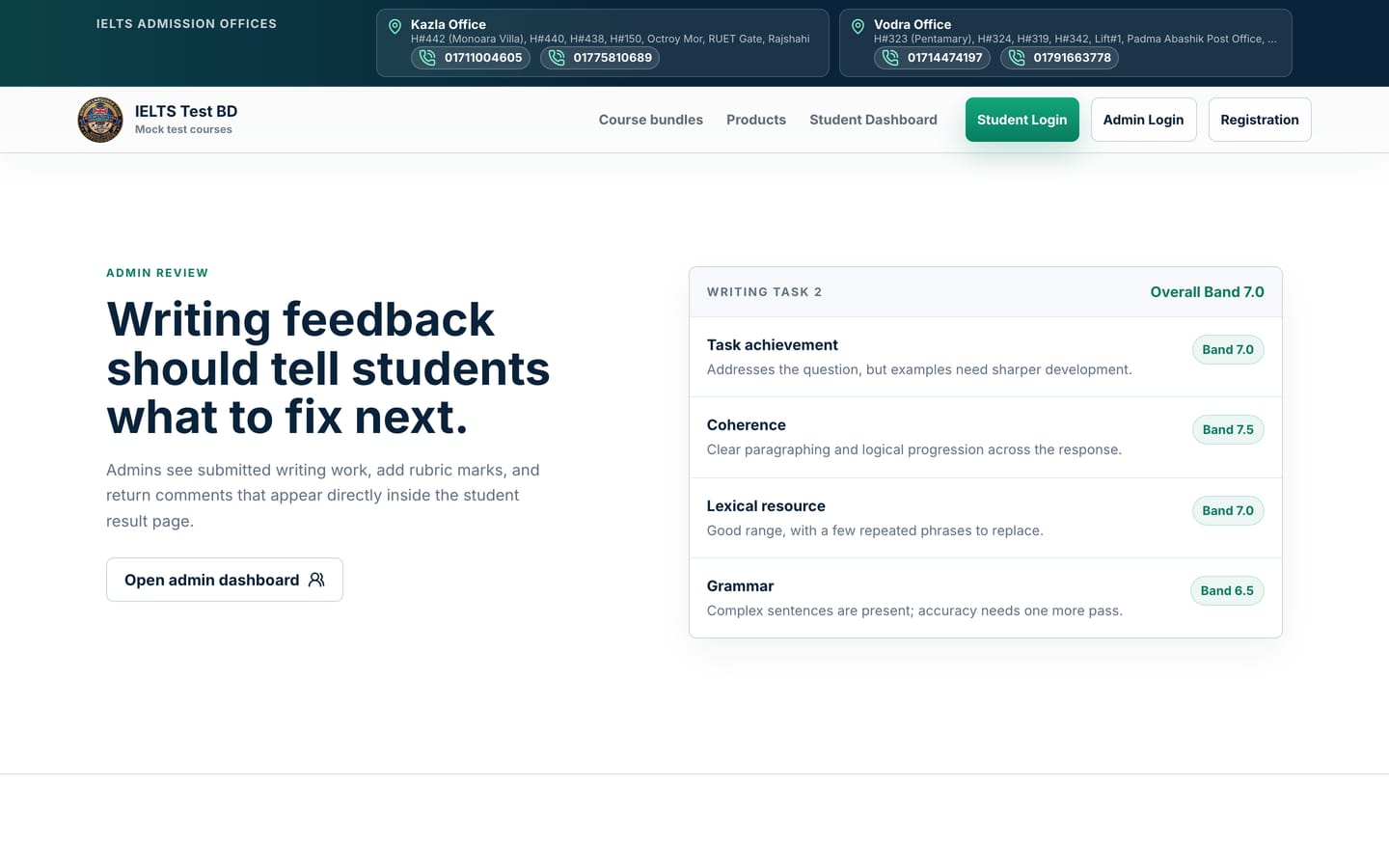
Writing is evaluated against the 4 IELTS criteria: task achievement, coherence, lexical resource and grammatical range. The platform produces a preliminary band and rubric notes, then an admin corrects or confirms them. The comments land directly in the student's result page rather than in a separate message.
Automated first pass, human final say
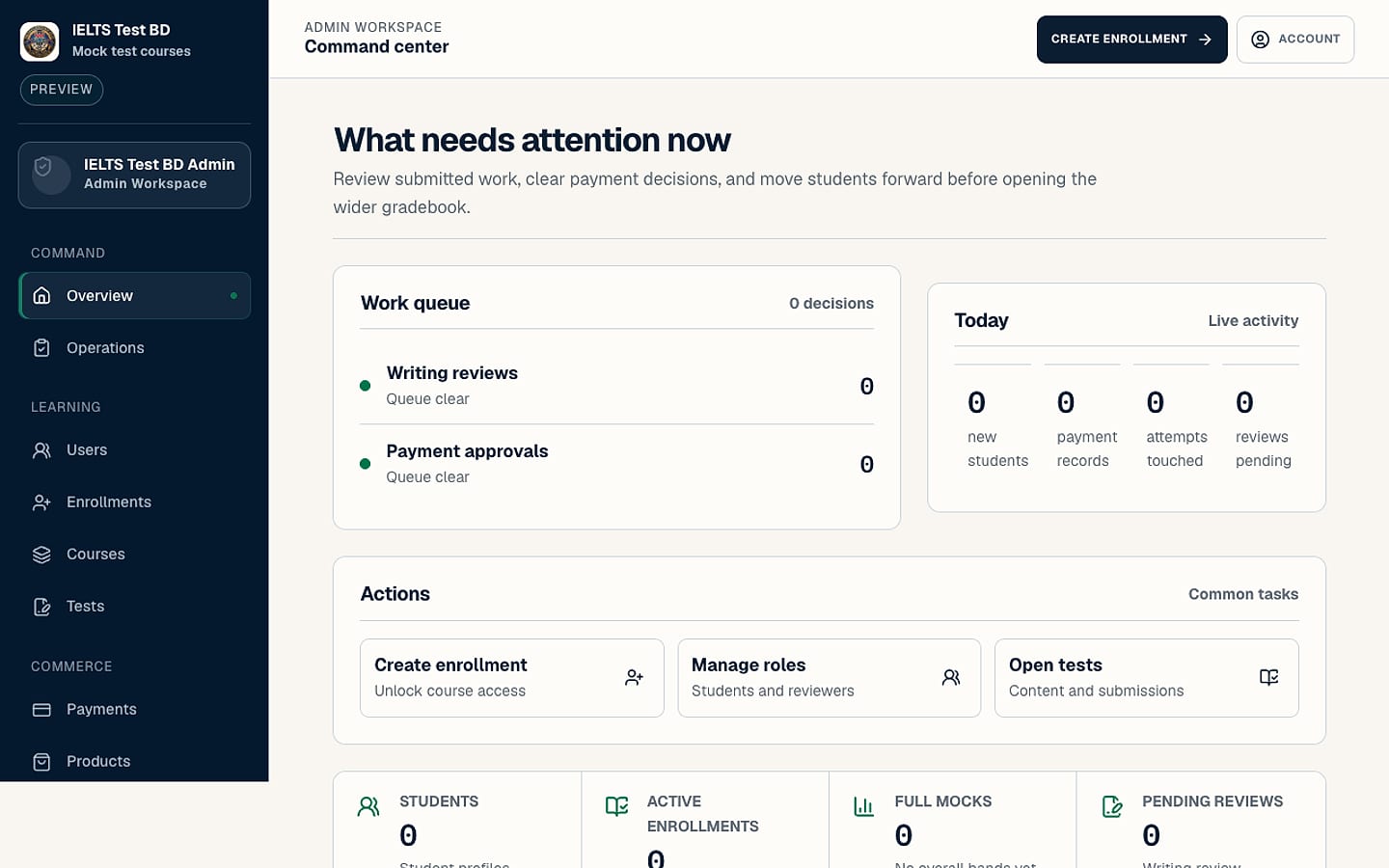
The first screen asks what needs attention now: writing reviews queued, payments awaiting approval, registrations submitted, and today's activity. Analytics exist, but they are not what an operator needs at 9am. Common tasks sit beside the queue so the next action is 1 click, not a navigation exercise.
Work queues before analytics, by design
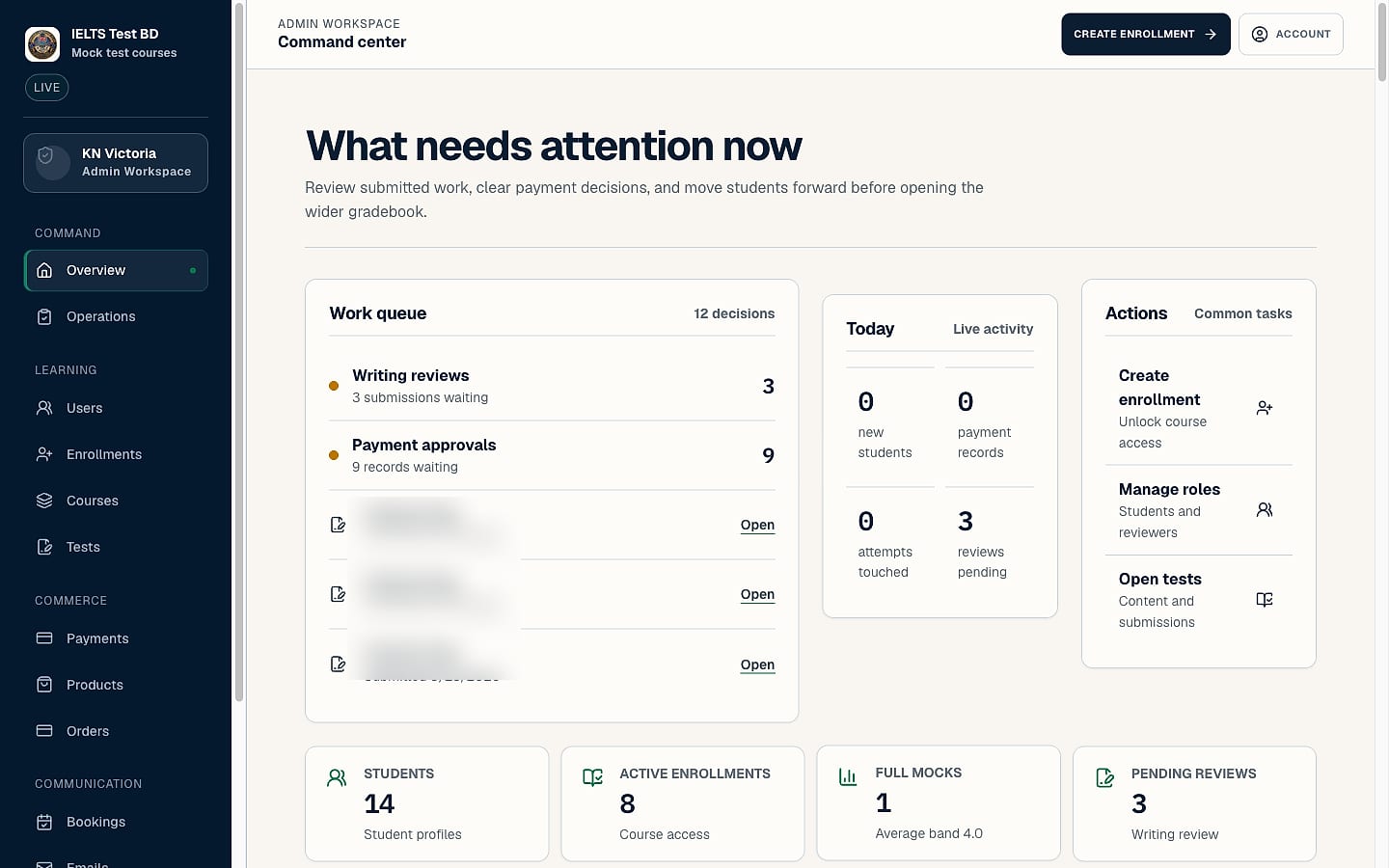
Results are grouped under the parent mock rather than listed as unrelated skill attempts, so a student is 1 row with 4 module states and an overall band. Submitted work opens straight from the queue. Student names in this view are blurred here for privacy; the live workspace shows them in full.
1 row per mock, not 4 per student
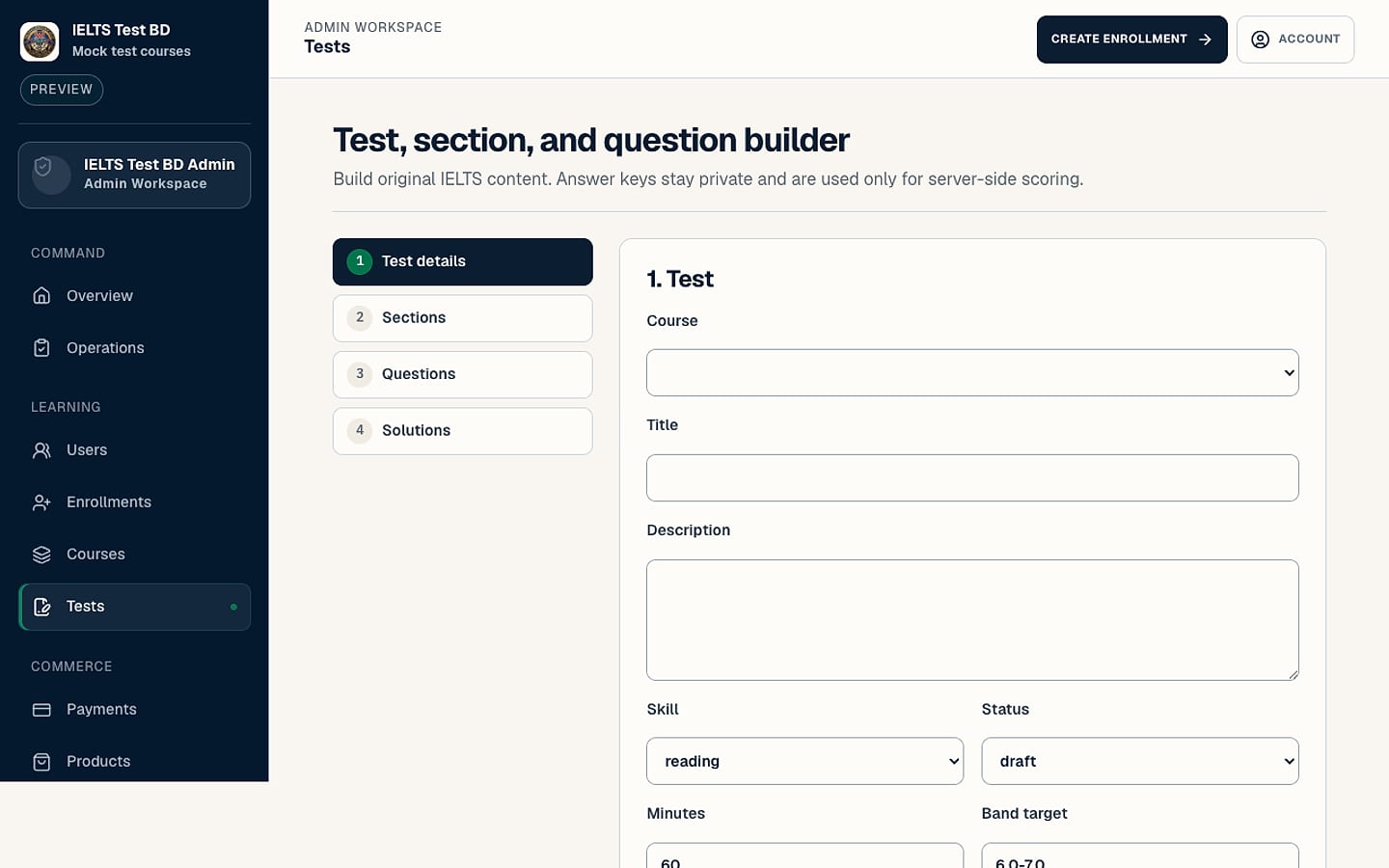
A 4 step builder covering test details, sections, questions and solutions, with skill, status, duration and band target set per test. Answer keys entered here stay on the server and are used only for scoring. Adding a new mock or a new Speaking variation is an afternoon in the admin, not a development ticket.
Answer keys never leave the server
An IELTS mock test is not a quiz. Getting it right online breaks most of what a normal web app assumes.
It needs a prompt, a voice, a recording, and a examiner-style judgement. Most platforms either omit it or post static cue cards, which is the module students most need to rehearse.
Listening and Reading can be marked mechanically, but Writing and Speaking need judgement. With one centre and hundreds of attempts, manual review becomes the bottleneck that caps enrolment.
Test sessions run 30 to 60 minutes on connections that are not always stable. Losing a Writing task to a reload is the fastest way to lose a student permanently.
A full mock is 4 modules back to back. Students working or studying full time need to split it across days without the platform treating that as an abandoned attempt.
Much of this market pays by mobile transfer and expects to send a transaction reference and a screenshot. A card-only checkout would exclude a large share of genuine buyers.
If correct answers ship to the browser with the questions, the test is worthless. They have to be withheld during the attempt and released only once it is submitted.
Set before the build, and the order decided what got solved first.
Listening, Reading, Writing and Speaking under one mock identity, so a student sees a test rather than 4 unrelated exercises.
Record in the browser, transcribe it, and return a criterion-based estimate, so the hardest module stops being the one that gets skipped.
Autosave to the server, keep a local draft as a second net, and restore the exact position on return.
Any skill on any day, scored independently, with the overall band assembled once all 4 are done.
Raw scores mean nothing to an IELTS candidate. Every module ends in a band estimate with feedback attached.
Mobile transfer with a reference and proof, reviewed and approved by a human, with a card gateway ready behind it.
Students, tests, scores, payments, registrations, documents and feedback in a single workspace instead of a spreadsheet and an inbox.
Where we chose a harder path, and what it bought.
Listening and Reading mark themselves against a server-held key. Writing and Speaking get an automated first pass that an admin can correct. That splits the work so volume scales without pretending a model has final say on a band.
Microphones are wrong, tabs get closed, uploads fail. So audio is checked before entry, each answer records separately and can be retried alone, and finished recordings are held in the browser's own storage so a reload does not erase them.
Naive autosave loses data when an older request finishes after a newer one. Saves are debounced and ordered, later writes cannot be overwritten by earlier ones, and local and server state are merged by timestamp rather than by whichever loaded last.
Correct answers are never part of the data the test page loads. They are applied during server-side scoring and released to the student through a separate endpoint only after submission, which is the only version of this that actually holds.
Most platforms bolt local payment on as an afterthought. Here the proof upload, the private storage, the admin review and the approval emails were built as the primary path, with the card gateway kept ready alongside it.
An operator's question is what needs deciding today, not how many users signed up this quarter. So the workspace opens on pending reviews, payments and registrations, and the analytics sit behind that.
The behaviour that separates a real mock from an online quiz.
4 stages, and what each one had to solve.
18 management screens, grouped by the job they do.
What separates this from the practice sites it competes with.
These count what was delivered. They describe scope, not traffic or revenue.
These describe how the platform changes the operation. They are not separately measured outcomes.
A student can rehearse a full Speaking test and get criterion feedback without an examiner sitting with them, which is the part of preparation that used to cap how many students the centre could serve.
Listening and Reading need no human at all, and Writing and Speaking arrive pre-scored with rubric notes, so review becomes confirmation rather than assessment from scratch.
The most common reason people abandon an online test is losing an hour to a reload. Two layers of saving mean a dropped connection costs seconds, not the attempt.
Independent modules let a working student practise in the time they actually have, which turns a full mock from a weekend commitment into 4 manageable sessions.
Accepting a mobile transfer with a reference and a screenshot, reviewed by a person, keeps the buyers a card-only checkout would have turned away.
Students, tests, scores, payments, registrations, documents and email live together, so the centre stops reconciling a spreadsheet against an inbox against a folder of receipts.
The whole platform, not a website with a quiz attached:
It runs the shape of a real Speaking interview, in a browser:
No, and the platform is deliberate about saying so:
Very little, which was the point:
Yes. This is the largest build in our portfolio and the pattern transfers:
If your teaching business grows only as fast as your staff can grade, the fix is a platform that does the mechanical part and leaves your people the judgement.